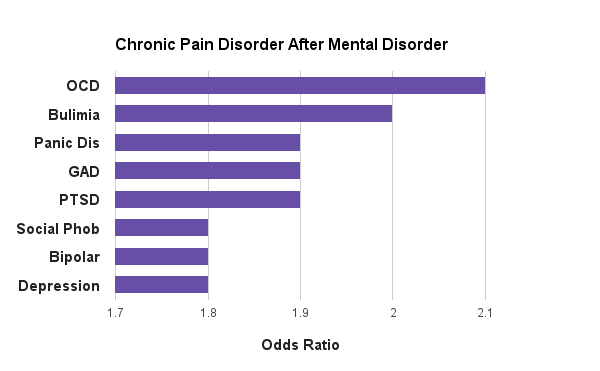
This is the fourth in a series of posts looking at some of the data from a study of chronic medical conditions following onset of a mental disorder (see citation below).
In this post I wanted to highlight the association of mental disorders with chronic pain conditions.
Onset of several anxiety disorders (OCD, panic disorder, generalized anxiety disorder, social phobia and PTSD) showed increased rates of later chronic pain by 80-110%.
Bulimia nervosa and mood disorders also showed later higher rates of chronic pain disorder.
Anxiety and mood disorders are commonly accompanied by significant physical symptoms including headaches and abdominal discomfort. Whether these features explain the association is unclear.
A take home message from this study is the need to carefully assess for mental disorder comorbidity in clinical populations with pain disorder. Additionally, use of narcotic analgesics is pain with comorbid mental disorders needs careful assessment and monitoring.
Follow the author on Twitter @WRY999
Scott KM, Lim C, Al-Hamzawi A, Alonso J, Bruffaerts R, Caldas-de-Almeida JM, Florescu S, de Girolamo G, Hu C, de Jonge P, Kawakami N, Medina-Mora ME, Moskalewicz J, Navarro-Mateu F, O'Neill S, Piazza M, Posada-Villa J, Torres Y, & Kessler RC (2015). Association of Mental Disorders With Subsequent Chronic Physical Conditions: World Mental Health Surveys From 17 Countries. JAMA psychiatry, 1-9 PMID: 26719969
There are a variety of methods to study the effects on exercise on brain function.
Brain imaging techniques such as fMRI provides a new tool to search for regional effects of acute and chronic exercise.
Another tool that has received less attention is the electroencephalogram or EEG. One EEG measure of brain function is the individual alpha peak frequency or iAPF.
The iAPF is positively correlated with arousal, attention and speed of information processing. Higher iAPF is linked to faster speed of information processing.
Boris Gutmann and colleagues from the German Sport University Cologne recently published a study of the effects on acute and chronic exercise on iAPF.
Here are the key elements in the design of their study:- Subjects: Ten males average age 22 who were regular participants in exercise but not highly trained endurance athletes
- Exercise: Time1- iAPF before and after exhaustive exercise and before and after steady state. Time2-iAPF before and after exhaustive exercise and before and after steady state. Time 1 and Time 2 exercise sessions were separated by four weeks that included steady state aerobic exercise training
The key findings from the study were:- iAPF was increased after exhaustive exercise but not following steady state exercise
- This effect occurred both at time 1 and time 2 suggesting it was independent of training
The authors note the arousal effect of exhaustive exercise may be "mediatede by changes in neural activity in the reticular-activating system".
I found it interesting that the effects of iAPF was limited to exhaustive exercise. In the exhaustive exercise protocol, subjects rode stationary bikes controlled by the researchers for intensity. Subjects started at 30 watts increased by 5 watts every 30 seconds until subjects reached exhaustion. The steady state exercise protocol was exercise on the bicycle for 30 minutes at 65-75% of maximal heart rate.
There appears to be some increasing research interest in the value of shorter periods of exhaustive exercise like that seen in interval training protocols. Increasing evidence supports the value of brief high intensity periods of exercise in promoting health benefits of exercise.
Using EEG markers may be helpful in examining the potential value of exercise in a variety of brain disorders, i.e. traumatic brain injury, attention deficit disorder, mood and anxiety disorders.
Readers with more interest in this study can access the free full-text manuscript by clicking on the PMID link below.
Photo of Captiva, FL sunset is from the author's files.
Follow the author on Twitter: @WRY999
Gutmann B, Mierau A, Hülsdünker T, Hildebrand C, Przyklenk A, Hollmann W, & Strüder HK (2015). Effects of physical exercise on individual resting state EEG alpha peak frequency. Neural plasticity, 2015 PMID: 25759762

Schubart and colleagues in the Netherlands and UCLA recently analyzed the rates of reporting psychotic experiences in European (primarily Dutch-speaking)adolescents and young adults. They looked specifically for the rates of endorsement of psychotic and mood symptoms in adolescents grouped by frequency and quantity of cannabis use.
Psychotic symptom experience is commonly grouped into what are known as positive symptoms or negative symptoms. Positive symptoms of psychosis typically include delusions, auditory hallucinations and visual hallucinations. Negative symptoms of psychosis typically include loss of motivation, withdrawal, and lack of goal directed productivity.
Over 17,000 young adults participated in the survey with over two thirds of the respondents being classified as users. Looking at the entire group of regular cannabis users, their scores on measures of psychosis and depressive symptoms did not differ from those who reported not using cannabis.
However, two factors among the users identified subgroups with signficant endorsement of symptoms of psychopathology:
- Cannabis users who initiated use before the age of 12 were three times more likely than non-users to be in the top 10% of scores on psychotic positive symptoms
- Regular heavy cannabis users (greater than 25 euros spent per week on cannabis) were 2.8 to 3.4 times more likely to be in the top 10% of scorers on scales of positive and negative psychotic symptoms as well as depressive symptoms.
The authors noted in the discussion that this cross-sectional design can not prove a causal pathway. It is possible that young people with psychotic symptoms may be more likely to begin using cannabis. Additionally, they note that young age of onset of cannabis use may also indicate a larger cumulative exposure that could be related to psychotic and mood symptoms.However, they do note their findings are consistent with the possibility that tetrahydrocannabinol (or other cannabis drugs)may have increased toxicity "during critical phases of brain maturation". There may be a window of vulnerability to the effcts of cannabis. Use after passing through this window, limited cannabis use may have limited cognitive effect. Early cannabis use and heavy chronic use may be a much different story.
Photo of a black and yellow argiope spider from North Palm Beach Florida courtesy of Yates Photography.
Schubart CD, van Gastel WA, Breetvelt EJ, Beetz SL, Ophoff RA, Sommer IE, Kahn RS, & Boks MP (2010). Cannabis use at a young age is associated with psychotic experiences. Psychological medicine, 1-10 PMID: 20925969