This is the fourth in a series of posts looking at some of the data from a study of chronic medical conditions following onset of a mental disorder (see citation below).
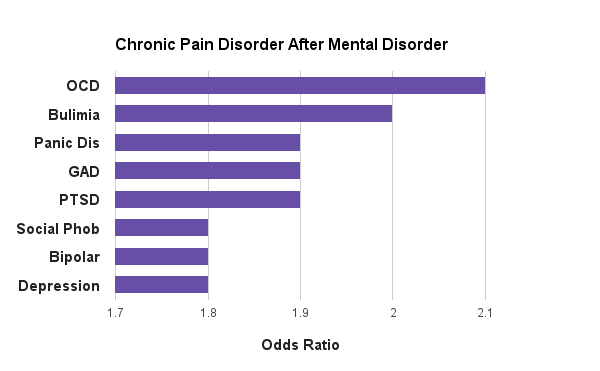
In this post I wanted to highlight the association of mental disorders with chronic pain conditions.
Onset of several anxiety disorders (OCD, panic disorder, generalized anxiety disorder, social phobia and PTSD) showed increased rates of later chronic pain by 80-110%.
Bulimia nervosa and mood disorders also showed later higher rates of chronic pain disorder.
Anxiety and mood disorders are commonly accompanied by significant physical symptoms including headaches and abdominal discomfort. Whether these features explain the association is unclear.
A take home message from this study is the need to carefully assess for mental disorder comorbidity in clinical populations with pain disorder. Additionally, use of narcotic analgesics is pain with comorbid mental disorders needs careful assessment and monitoring.
Follow the author on Twitter @WRY999
Scott KM, Lim C, Al-Hamzawi A, Alonso J, Bruffaerts R, Caldas-de-Almeida JM, Florescu S, de Girolamo G, Hu C, de Jonge P, Kawakami N, Medina-Mora ME, Moskalewicz J, Navarro-Mateu F, O'Neill S, Piazza M, Posada-Villa J, Torres Y, & Kessler RC (2015). Association of Mental Disorders With Subsequent Chronic Physical Conditions: World Mental Health Surveys From 17 Countries. JAMA psychiatry, 1-9 PMID: 26719969
Showing posts with label PTSD. Show all posts
Monday, 18 January 2016
Friday, 8 January 2016
Heart Disease Risk Following Mental Disorders
This is the second in a series looking at the recent study of physical illness in those with a diagnosis of a mental disorder.
Today, I am published a chart of the mental disorders associated with increased risk for report of heart disease at a later time.
Alcohol and drug dependence diagnoses are associated with the highest risk of later heart disease. The odds ratio estimates this increase at better two and three times higher than those without an alcohol or drug dependence diagnosis.
Two specific anxiety disorder conditions also show association with later heart disease, panic disorder and PTSD.
Additionally, bulimia nervosa and bipolar disorder also show greater rates of heart disease although these associations are at around 60% to 80% higher rates.
These associations do not prove causality. For example heart disease may share susceptibility genes with some mental disorders.
Nevertheless, these associations should prompt rigorous medical heart disease surveillance in those with substance abuse and anxiety disorders.
Follow the author on Twitter WRY999
Chart is an original figure created using data from the manuscript cited below.
Scott KM, Lim C, Al-Hamzawi A, Alonso J, Bruffaerts R, Caldas-de-Almeida JM, Florescu S, de Girolamo G, Hu C, de Jonge P, Kawakami N, Medina-Mora ME, Moskalewicz J, Navarro-Mateu F, O'Neill S, Piazza M, Posada-Villa J, Torres Y, & Kessler RC (2015). Association of Mental Disorders With Subsequent Chronic Physical Conditions: World Mental Health Surveys From 17 Countries. JAMA psychiatry, 1-9 PMID: 26719969
Today, I am published a chart of the mental disorders associated with increased risk for report of heart disease at a later time.
Alcohol and drug dependence diagnoses are associated with the highest risk of later heart disease. The odds ratio estimates this increase at better two and three times higher than those without an alcohol or drug dependence diagnosis.
Two specific anxiety disorder conditions also show association with later heart disease, panic disorder and PTSD.
Additionally, bulimia nervosa and bipolar disorder also show greater rates of heart disease although these associations are at around 60% to 80% higher rates.
These associations do not prove causality. For example heart disease may share susceptibility genes with some mental disorders.
Nevertheless, these associations should prompt rigorous medical heart disease surveillance in those with substance abuse and anxiety disorders.
Follow the author on Twitter WRY999
Chart is an original figure created using data from the manuscript cited below.
Scott KM, Lim C, Al-Hamzawi A, Alonso J, Bruffaerts R, Caldas-de-Almeida JM, Florescu S, de Girolamo G, Hu C, de Jonge P, Kawakami N, Medina-Mora ME, Moskalewicz J, Navarro-Mateu F, O'Neill S, Piazza M, Posada-Villa J, Torres Y, & Kessler RC (2015). Association of Mental Disorders With Subsequent Chronic Physical Conditions: World Mental Health Surveys From 17 Countries. JAMA psychiatry, 1-9 PMID: 26719969
Tuesday, 2 June 2015
Neurobiology of Child Neglect/Abuse: Nemeroff Lecture Notes
I had the opportunity to attend the Warren Neuroscience Lecture presented by Dr. Charles Nemeroff in Tulsa, OK on June 2, 2015.
Dr. Nemeroff has been an international leader in research in mood and anxiety disorders. His recent focus has been on the effects of adverse childhood environments on risk for adult mood and anxiety disorders.
Here are my notes that summarize some of the key points from his lecture.
Introduction:
Psychiatry research slowed by complexity of brain, multiple cell types, complex heterogeneous disorders. But we are beginning to understand the key role genes play in a variety of key disorders. Genetic factors account for 65% of bipolar disorder variance, 50% of schizophrenia variance and around 35% of variance in major depression.
Early childhood abuse and neglect is common. Recent surveys estimate prevalence rates for each of the following:
Early childhood abuse and neglect has multiple effects in neurobiology and later adult mood and anxiety disorder risk:
There is a growing body of evidence that ten or more genes influence vulnerability to childhood abuse and neglect including genes regulating the HPA axis, serotonin function and a gene known as FKBP5. These genetic effects may interact with environmental stresses to reduce or amplify stress vulnerability. Stress may be viewed as a teratogen that influences genetic features through epigenetic and gene regulation effects.
During the discussion following the lecture Dr. Nemeroff noted the importance of population-based efforts to reduce societal levels of exposure to child abuse and neglect including:
Below I have added citations featured in the presentation to allow readers with more interest to delve into some of the primary research studies.
Image is this post is "PBB Protein CRH image" from Wikipedia chapter on CRH. Image by ProteinBoxBot. Licensed under Public Domain via Wikimedia Commons
Follow the author on Twitter @WRY999
Heim C, Newport DJ, Heit S, Graham YP, Wilcox M, Bonsall R, Miller AH, & Nemeroff CB (2000). Pituitary-adrenal and autonomic responses to stress in women after sexual and physical abuse in childhood. JAMA, 284 (5), 592-7 PMID: 10918705
Heim C, Mletzko T, Purselle D, Musselman DL, & Nemeroff CB (2008). The dexamethasone/corticotropin-releasing factor test in men with major depression: role of childhood trauma. Biological psychiatry, 63 (4), 398-405 PMID: 17825799
Binder EB, Bradley RG, Liu W, Epstein MP, Deveau TC, Mercer KB, Tang Y, Gillespie CF, Heim CM, Nemeroff CB, Schwartz AC, Cubells JF, & Ressler KJ (2008). Association of FKBP5 polymorphisms and childhood abuse with risk of posttraumatic stress disorder symptoms in adults. JAMA, 299 (11), 1291-305 PMID: 18349090
Saveanu, R., & Nemeroff, C. (2012). Etiology of Depression: Genetic and Environmental Factors Psychiatric Clinics of North America, 35 (1), 51-71 DOI: 10.1016/j.psc.2011.12.001
Dr. Nemeroff has been an international leader in research in mood and anxiety disorders. His recent focus has been on the effects of adverse childhood environments on risk for adult mood and anxiety disorders.
Here are my notes that summarize some of the key points from his lecture.
Introduction:
- Stress is an important factor in understanding depression
- Early life stress is a risk factor for later adult depression
- Genes account for a significant portion of the variation in risk following stress exposure
- Brain systems that regulate emotions are disrupted during episodes of major depression
Psychiatry research slowed by complexity of brain, multiple cell types, complex heterogeneous disorders. But we are beginning to understand the key role genes play in a variety of key disorders. Genetic factors account for 65% of bipolar disorder variance, 50% of schizophrenia variance and around 35% of variance in major depression.
Early childhood abuse and neglect is common. Recent surveys estimate prevalence rates for each of the following:
- Physical abuse 15-28% of general population in U.S.
- Sexual abuse in 11-21%
- Emotional abuse in 11-36%
- Parental divorce or separation in 25%
Early childhood abuse and neglect has multiple effects in neurobiology and later adult mood and anxiety disorder risk:
- Increased adult cerebral spinal marker of stress known as corticotrophin releasing factor (CRF)
- Increase serum ACTH and cortisol
- Increase inflammatory markers such as interleukin-6
- Decreased cerebral spinal fluid oxytocin that may impair social function and bonding with children
- Reduced brain cortex thickness and hyperactivy amygdala response
- Increased adult PTSD and depression
- Increased adult rates of substance abuse
- Increased risk of suicidal behavior and completed suicide
There is a growing body of evidence that ten or more genes influence vulnerability to childhood abuse and neglect including genes regulating the HPA axis, serotonin function and a gene known as FKBP5. These genetic effects may interact with environmental stresses to reduce or amplify stress vulnerability. Stress may be viewed as a teratogen that influences genetic features through epigenetic and gene regulation effects.
For clinicians there are important treatment implications:
- Major depression in the context of moderate to severe childhood abuse is less responsive to medication or to psychotherapy intervention
- Childhood abuse and neglect in bipolar disorder is linked to early onset, greater severity and poor treatment response.
During the discussion following the lecture Dr. Nemeroff noted the importance of population-based efforts to reduce societal levels of exposure to child abuse and neglect including:
- Early education with teacher training to look for evidence of abuse/neglect
- Increased training for primary care physicians treating infants/children
- Increased training and funding for social services that evaluate and treat children referred for child abuse/neglect
- Increased detection and surveillance for sexual predators
- More research in the treatment of sexual disorders including pedophilia. There is almost no NIH funding in this area and little research interest and activity.
Below I have added citations featured in the presentation to allow readers with more interest to delve into some of the primary research studies.
Follow the author on Twitter @WRY999
Heim C, Newport DJ, Heit S, Graham YP, Wilcox M, Bonsall R, Miller AH, & Nemeroff CB (2000). Pituitary-adrenal and autonomic responses to stress in women after sexual and physical abuse in childhood. JAMA, 284 (5), 592-7 PMID: 10918705
Heim C, Mletzko T, Purselle D, Musselman DL, & Nemeroff CB (2008). The dexamethasone/corticotropin-releasing factor test in men with major depression: role of childhood trauma. Biological psychiatry, 63 (4), 398-405 PMID: 17825799
Binder EB, Bradley RG, Liu W, Epstein MP, Deveau TC, Mercer KB, Tang Y, Gillespie CF, Heim CM, Nemeroff CB, Schwartz AC, Cubells JF, & Ressler KJ (2008). Association of FKBP5 polymorphisms and childhood abuse with risk of posttraumatic stress disorder symptoms in adults. JAMA, 299 (11), 1291-305 PMID: 18349090
Saveanu, R., & Nemeroff, C. (2012). Etiology of Depression: Genetic and Environmental Factors Psychiatric Clinics of North America, 35 (1), 51-71 DOI: 10.1016/j.psc.2011.12.001
Wednesday, 14 September 2011
Real-Time fMRI Psychotherapy
| Old World Psychotherapy: Sofa of Sigmund Freud |
Now a study published in Plos One summarizes the results of study examining the use of real-time fMRI to provide neurofeedback during an amygdala activation task.
This research was completed by neuroscientists affiliated with the Laureate Institute of Brain Research in Tulsa, Oklahoma and George Mason University in Fairfax, Virginia. (Disclosure: The author of Brain Posts is employed by Laureate Institute of Brain Research but was not involved in the study reviewed in this post.)
The authors of this study noted the key role of the amygdala in the processing of emotions. They developed a experimental paradigm to train control subjects to increase the activation of the brain left amygdala. A group of young male subjects were instructed in a happy autobiographical memory task and provided real-time feedback on how successful they were in increasing blood flow to the left amygdala.
Subjects identified three key happy memories from their past. During the experimental phase, they were instructed to recall these specific memories while being scanned using an fMRI scanner. They were provided real-time feedback on a monitor screen on the changes in left amygdala BOLD signal. (Subjects were told prior to scanning that fMRI neurofeedback is delayed by a few seconds due to the brain hemodynamic process).
Subjects provided real-time feedback were more successful at increasing the left amygdala activation than those in a control group. This increase in the experimental group correlated with increases in other brain areas known to have functional connectivity with the amygdala (fronto-temporo-limbic network).
![]() |
| New World Psychotherapy: Real Time fMRI |
- right medial frontal cortex
- bilateral dorsomedial prefrontal cortex
- left anterior cingulate cortex
- bilateral superior frontal gyrus
Subjects were selected based on being free of a history of neuropsychiatric disorders including anxiety and depression. However, there was some variability in the level of change in left amygdala activation with neurofeedback training. Subjects who scored high on the Difficulty Identifying Feelings scale had less increase in the left amygdala. Additionally, subjects with higher scores on a scale of being susceptible to anger showed less increase.
This research is an very important advance in understanding the amygdala and regions connected with the amygdala. Additionally, it raises the possibility that real-time fMRI may emerge as a tool to understand processes associated with psychotherapy and to be an emerging model for providing therapy under real-time neurofeedback conditions.
The site of psychotherapy might be moving from the sofa model of Sigmund Freud to the fMRI scanner. Both methods have subjects that lie down, but only the fMRI method provides real-time feedback of brain effects related to a psychotherapy intervention.
The authors note that this study was a type of "proof-of-concept" study since it focused on healthy control subjects. They suggest that this type of model might be particularly relevant to cognitive behavioral treatment of conditions such as PTSD and major depression.
Photo of Sigmund Freud sofa from the Freud Museum in London from Wikipedia distributed under the GNU Free Documentation License.
Photo of Functional Magnetic Research Imaging device courtesy of the Laureate Institute for Brain Research.
Zotev, V., Krueger, F., Phillips, R., Alvarez, R., Simmons, W., Bellgowan, P., Drevets, W., & Bodurka, J. (2011). Self-Regulation of Amygdala Activation Using Real-Time fMRI Neurofeedback PLoS ONE, 6 (9) DOI: 10.1371/journal.pone.0024522
Saturday, 27 November 2010
The Epidemiology of Trauma in PTSD-II
In a previous post, I looked at the varieties of traumatic experiences and their risk of inducing PTSD in men and women. Another aspect of the epidemiology of PTSD is a more basic look at the overall prevalence of exposure to individual traumatic experiences.
There has been significant discussion and research to define the trauma severity required to increase risk of a PTSD response. Early studies tended to have a lower threshold for severity. They included not only a personal experience of trauma but also learning that a friend or family member had experienced trauma. More recent research has required a more direct personal experience for the traumatic experience.
Using an earlier, less restrictive definition, up to ninety percent of survey population reported at least one trauma significant enough for PTSD. The most prevalent traumatic experiences (1996 Detroit area survey)
1. Sudden unexpecte death of a close friend or relative (60%)
2. Learned close friend/relative was seriously injured in a motor vehicle crash (39%)
3. Learned that a close friend/relative was raped or sexually assaulted (33%)
4. Witnessed someone being killed or seriously injured (29%)
5. Personal serious car or motor vehicle crash (28%)
The WHO international study of trauma used a more restrictive list of serious traumatic events and found the prevalence rates for lifetime trauma ranged between 2 and 31%. The most common traumas reported among those with a traumatic experience were:
1. Death of a loved one (31%)
2. Witness to violence (22%)
3. Interpersonal violence (19%)
4. Accidents (18%)
5. Exposure to war (16%)
6. Trauma to a loved one (13%)
Look forward to additional description of the WHO survey of prevalence and patterns of trauma exposure throughout the world.
Photo of Kenyan Zebra Courtesy of Sarah Yates
Breslau, N. (1998). Trauma and Posttraumatic Stress Disorder in the Community: The 1996 Detroit Area Survey of Trauma Archives of General Psychiatry, 55 (7), 626-632 DOI: 10.1001/archpsyc.55.7.626
Stein DJ, Chiu WT, Hwang I, Kessler RC, Sampson N, Alonso J, Borges G, Bromet E, Bruffaerts R, de Girolamo G, Florescu S, Gureje O, He Y, Kovess-Masfety V, Levinson D, Matschinger H, Mneimneh Z, Nakamura Y, Ormel J, Posada-Villa J, Sagar R, Scott KM, Tomov T, Viana MC, Williams DR, & Nock MK (2010). Cross-national analysis of the associations between traumatic events and suicidal behavior: findings from the WHO World Mental Health Surveys. PloS one, 5 (5) PMID: 20485530
There has been significant discussion and research to define the trauma severity required to increase risk of a PTSD response. Early studies tended to have a lower threshold for severity. They included not only a personal experience of trauma but also learning that a friend or family member had experienced trauma. More recent research has required a more direct personal experience for the traumatic experience.
Using an earlier, less restrictive definition, up to ninety percent of survey population reported at least one trauma significant enough for PTSD. The most prevalent traumatic experiences (1996 Detroit area survey)
1. Sudden unexpecte death of a close friend or relative (60%)
2. Learned close friend/relative was seriously injured in a motor vehicle crash (39%)
3. Learned that a close friend/relative was raped or sexually assaulted (33%)
4. Witnessed someone being killed or seriously injured (29%)
5. Personal serious car or motor vehicle crash (28%)
The WHO international study of trauma used a more restrictive list of serious traumatic events and found the prevalence rates for lifetime trauma ranged between 2 and 31%. The most common traumas reported among those with a traumatic experience were:
1. Death of a loved one (31%)
2. Witness to violence (22%)
3. Interpersonal violence (19%)
4. Accidents (18%)
5. Exposure to war (16%)
6. Trauma to a loved one (13%)
Look forward to additional description of the WHO survey of prevalence and patterns of trauma exposure throughout the world.
Photo of Kenyan Zebra Courtesy of Sarah Yates
Breslau, N. (1998). Trauma and Posttraumatic Stress Disorder in the Community: The 1996 Detroit Area Survey of Trauma Archives of General Psychiatry, 55 (7), 626-632 DOI: 10.1001/archpsyc.55.7.626
Stein DJ, Chiu WT, Hwang I, Kessler RC, Sampson N, Alonso J, Borges G, Bromet E, Bruffaerts R, de Girolamo G, Florescu S, Gureje O, He Y, Kovess-Masfety V, Levinson D, Matschinger H, Mneimneh Z, Nakamura Y, Ormel J, Posada-Villa J, Sagar R, Scott KM, Tomov T, Viana MC, Williams DR, & Nock MK (2010). Cross-national analysis of the associations between traumatic events and suicidal behavior: findings from the WHO World Mental Health Surveys. PloS one, 5 (5) PMID: 20485530
Friday, 26 November 2010
The Epidemiology of Trauma in PTSD
PTSD represents a pathological response to a serious trauma. The evolution of the diagnostic criteria for PTSD has included a broadening of the types of trauma exposures felt sufficient to trigger PTSD. The original criteria included combat, concentration camp confinement, natural disaster, rape or physical assault. The current DSM-IV criteria for trauma require that "the person experienced, witnessed or was confronted with an event(s) that involved actual or threatened death or serious injury or a threat to the physical integrity of self or others"
Naomi Breslau from the Michigan State summarized the current state of knowledge regarding the epidemiology of trauma and PTSD--much of which she has been a key research leader. With the expanded trauma trigger definition, it is estimated approximately 40 to 80% of the U.S. population have experienced one of these traumas. General population surveys of PTSD complement our knowledge of PTSD outside military personnel.
Only a minority of trauma exposures appear to result in PTSD. Women appear more vulnerable to a PTSD response than men. Here is the estimated highest risk traumas for women (% of individuals experiencing the trauma who develop PTSD):
Women
In addition to female gender, presence of a prior childhood anxiety disorder appears to increase risk. Higher IQ (>115) appears to provide some protective effect.
Prevention of PTSD starts with public health efforts to reduce violent crime and the frequency of severe trauma exposure in the population. Military service related trauma is also a key area for prevention and early intervention. Secondary prevention efforts include identifying those exposed to serious trauma, assessing for high risk for PTSD following this trauma and early therapy or pharmacologic intervention.
Photo of male lion in Kenya courtesy of Sarah Yates
Breslau N (2009). The epidemiology of trauma, PTSD, and other posttrauma disorders. Trauma, violence & abuse, 10 (3), 198-210 PMID: 19406860
Naomi Breslau from the Michigan State summarized the current state of knowledge regarding the epidemiology of trauma and PTSD--much of which she has been a key research leader. With the expanded trauma trigger definition, it is estimated approximately 40 to 80% of the U.S. population have experienced one of these traumas. General population surveys of PTSD complement our knowledge of PTSD outside military personnel.
Only a minority of trauma exposures appear to result in PTSD. Women appear more vulnerable to a PTSD response than men. Here is the estimated highest risk traumas for women (% of individuals experiencing the trauma who develop PTSD):
Women
- Held captured/tortured (78%)
- Severe physical assault with injury (56%)
- Rape (49%)
- Lesser assault (36%)
- Serious accident (28%)
- Sexual assault other than rape (24%)
- Shot or stabbed (18%)
- Child life threatening illness (18%)
- Sexual assault (16%)
- Sudden, unexpected death of relative or friend (13%)
- Witnessing a killing/serious injury (9%)
In addition to female gender, presence of a prior childhood anxiety disorder appears to increase risk. Higher IQ (>115) appears to provide some protective effect.
Prevention of PTSD starts with public health efforts to reduce violent crime and the frequency of severe trauma exposure in the population. Military service related trauma is also a key area for prevention and early intervention. Secondary prevention efforts include identifying those exposed to serious trauma, assessing for high risk for PTSD following this trauma and early therapy or pharmacologic intervention.
Photo of male lion in Kenya courtesy of Sarah Yates
Tuesday, 21 September 2010
The Neurobiology of Anxiety Disorders
A key question in the classification of anxiety disorders is whether the DSM-IV classification system describes distinct useful categories. There is a great deal of overlap in clinical populations. You do not find many individual who have one unique disorder. Typically, someone with say panic disorder is likely to have one or more additional anxiety disorder such as social phobia or PTSD. A key question is whether there is a broader anxiety disorder phenotype that might include a variety of symptoms found in specific anxiety disorders.
If specific anxiety disorders describe specific phenotypes, there should be evidence from what we know about the neurobiology of these disorders. A recent comprehensive review of this issue has been published in the 2009 September issue of Psychiatric Clinics of North America and has been republished in Clinical and Laboratory Medicine. The authors of this review make the argument that “there exist many distinguishing features that support the continued classification of individual anxiety disorders that are distinct from each other and from major depression.” I will summarize some of their highlights for several of the individual anxiety, disorders. The authors group their findings into anatomical and functional imaging findings, neuroendocrine and neurotransmitter, and genetic domains. I will focus on the anatomical and functional imaging domains and refer the reader to the original manuscript for the other domains.
Panic Disorder
- Decreased glucose metabolism in parietal lobe and overall decreased cerebral blood flow
- Elevated glucose metabolism in amygdale, hippocampus, thalamus, midbrain and cerebellum
- Elevations normalize with successful treatment with behavioral or pharmacotherapy
- Panic attacks are linked with hyperactivity burst in right amygdale
- Anxious visual stimuli provoke increased activity in inferior frontal cortex, hippocampus, anterior and posterior cingulated cortex and orbitofrontal cortex
Posttraumatic Stress Disorder
- Severity of PTSD linked to greater activation of amygdale in response to fearful faces
- Ventral activation of anterior cingulate cortex with fearful faces predicts poor response to cognitive behavioral therapy
- PTSD patients activate the executive function network with combat-related images—this network is typically not activated in normals for emotional/affective processing tasks
- PTSD patients anxiety overwhelms brain inhibitory network producing more errors with cognitive tasks
Social Phobia
- Anticipation of public speaking tasks excessively elevates activation of subcortical, limbic and lateral paralimbic regions
- Response to trazodone in social phobia linked to decreased blood flow to ventral and dorsl anterior cingulate cortex and prefrontal cortex and increased cerebral blood flow to middle cingulated cortex, left hippocampus and parahippocampal gyrus
- Misinterpretation of social cues due to dysfunction of the cortico-striato-thalamic network
Generalized Anxiety Disorder
- Pediatric patients with generalized anxiety show enlargement of amygdale
- Elevated prefrontal cortex resting activity felt to be an anxiety compensatory response
- Elevated amygdala and insular cortex activation with angry faces
- Venlafaxine drug response tied to lower pretreatment amygdala activity and higher anterior cingulated activity
One of the methodological problems with imaging, neurotransmitter and genetic studies in anxiety disorders is the issue of identifying individuals with a unique anxiety disorder. Even this strategy may be problematic. Studying a young adult patient with a unique panic disorder diagnosis does not account for the possibility of later development another anxiety disorder such as social phobia or PTSD.
Although a great deal of progress has been made in the neurobiology of anxiety disorders, the challenge of understanding the best classification strategies remain. Clinicians are typically, left with a implementing a trial of a selective serotonin re-uptake inhibitor or cognitive behavior therapy in patients with a single or multiple anxiety disorder diagnoses. The jury is out whether neurobiology can lead to improved and more specific treatments.
Photo of Tiger Woods Chipping at 2010 PGA Championship Courtesy of Yates Photography
Martin EI, Ressler KJ, Binder E, & Nemeroff CB (2009). The neurobiology of anxiety disorders: brain imaging, genetics, and psychoneuroendocrinology. The Psychiatric clinics of North America, 32 (3), 549-75 PMID: 19716990
Subscribe to:
Posts (Atom)


