Showing posts with label anxiety disorder. Show all posts

Monday, 18 January 2016

Chronic Pain Following Mental Disorders

This is the fourth in a series of posts looking at some of the data from a study of chronic medical conditions following onset of a mental disorder (see citation below).

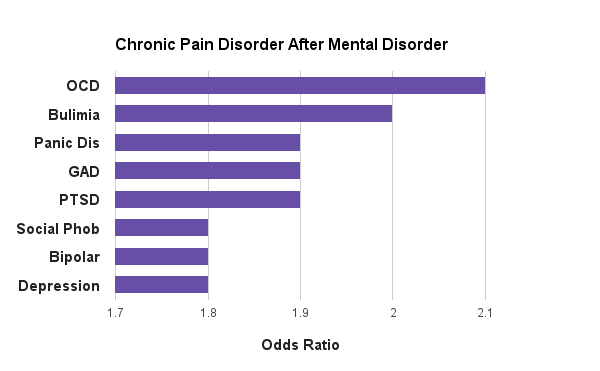
In this post I wanted to highlight the association of mental disorders with chronic pain conditions.

Onset of several anxiety disorders (OCD, panic disorder, generalized anxiety disorder, social phobia and PTSD) showed increased rates of later chronic pain by 80-110%.

Bulimia nervosa and mood disorders also showed later higher rates of chronic pain disorder.

Anxiety and mood disorders are commonly accompanied by significant physical symptoms including headaches and abdominal discomfort. Whether these features explain the association is unclear.

A take home message from this study is the need to carefully assess for mental disorder comorbidity in clinical populations with pain disorder. Additionally, use of narcotic analgesics is pain with comorbid mental disorders needs careful assessment and monitoring.

Follow the author on Twitter @WRY999

Scott KM, Lim C, Al-Hamzawi A, Alonso J, Bruffaerts R, Caldas-de-Almeida JM, Florescu S, de Girolamo G, Hu C, de Jonge P, Kawakami N, Medina-Mora ME, Moskalewicz J, Navarro-Mateu F, O'Neill S, Piazza M, Posada-Villa J, Torres Y, & Kessler RC (2015). Association of Mental Disorders With Subsequent Chronic Physical Conditions: World Mental Health Surveys From 17 Countries. JAMA psychiatry, 1-9 PMID: 26719969

Tuesday, 23 June 2015

Bipolar Disorder Linked to Increased Dementia Risk

A variety of risk factors have been identified in Alzheimer's disease and other types of dementia.

The risk for dementia following major psychiatric syndromes in mid-life is an important research area.

Renate Zilkens and colleagues in Australia recently published an informative study of psychiatric disorders and later dementia risk. This study used a population-based case control methodology.

The key elements in the design of this study included the following:

  • Subjects: General population in Western Australia
  • Data sources: inpatient, outpatient and emergency medical records along with death records
  • Cases: Incident cases of dementia between ages of 65 and 84 years of age
  • Controls: Age and sex-matched individuals without incident dementia diagnosis
  • Psychiatric diagnoses: medical record diagnoses that were required to be present at least ten years prior to dementia onset
  • Statistical analysis: odds ratio using conditional logistic regression


The research group in this study used a variety of models to assess risk based on specific medical and psychiatric disorders.

For simplicity, I have used data from the study to put together the summary graph in this post.

This graph estimates later dementia odds ratios for specific disorders when that disorder is present during the 65-69 year age period.

There is evidence of a strong increase in risk for dementia following bipolar disorder diagnosis (odds ratio 4.71, 95% confidence interval 2.29 to 9.65). Bipolar disorder is the psychiatric disorder with the second highest odds ratio being topped only by schizophrenia with an estimated odds ratio of 12.1. The odds ratio with depression was only slight lower than that associated with a diabetes diagnosis (odds ratio 2.77 vs 3.47). Anxiety disorder had a small but statistically significant increased odds ration for later dementia (odds ratio 1.37, 95% confidence interval 1.14-1.65)

Alcoholism diagnosis by age 65 years of age is also associated with a marked increase in dementia risk (odds ratio 4.14, 95% confidence interval 2.25 to 7.61).

The authors note their findings support the role of psychiatric disorders in contributing to brain vascular abnormalities that can contribute to later cognitive decline. Additionally, they note there is increasing evidence that psychiatric disorders are associated with brain inflammation and immune system dysfunction, areas know to contribute to cognitive decline.

This study is important is suggests at lease five psychiatric disorders need to be considered as potential risk factors for dementia (bipolar disorder plus schizophrenia, depression, anxiety and alcoholism). Adding these risk factors may allow for improvement in detection and prevention efforts.

Additionally, the finding suggest dementia populations may have higher rates of psychiatric disorders. These psychiatric disorders can complicate dementia management and increase the need for psychiatric assessment and consultation in geriatric care settings.

Readers with more interest in this topic can access the free full-text manuscript by clicking on DOI link below.

Follow the author on Twitter @WRY999

Zilkens, R., Bruce, D., Duke, J., Spilsbury, K., & Semmens, J. (2014). Severe Psychiatric Disorders in Mid-Life and Risk of Dementia in Late- Life (Age 65-84 Years): A Population Based Case-Control Study Current Alzheimer Research, 11 (7), 681-693 DOI: 10.2174/1567205011666140812115004

Tuesday, 13 September 2011

Serotonin, Social Interaction and Making Decisions

The role of specific neurotransmitters and neurotransmitter circuits in decision making is being explored in a variety of ways.  Dopamine appears to have significant research support for a key role in making decisions related to reward.


The role of serotonin in decision making is less well studied but also appears to be important.  Robert Rogers, Ph.D. recently presented some of his lab's research at the Warren Frontiers in Neuroscience lecture in Tulsa, Oklahoma.  (Additionally, I have reviewed and placed a link to a recent research manuscript from Dr. Rogers related to topic below.)


Dr. Rogers noted the relationship between serotonin, depression and social function include these research findings:
  • Social isolation is a known risk factor for major depression
  • Serotonin appears important in developing nourishing social contacts
  • Social isolation found in anxiety and depression may be mediated by serotonin mechanisms
Serotonin mechanisms in human research is aided by the safe ability to modulate brain serotonin levels.  Brain serotonin can be temporarily depleted using a amino acid drink deficient in the serotonin precursor L-tryptophan.  Humans without mood or anxiety disorders show an increase in brain serotonin after a week of administration of any of commonly used selective serotonin reuptake inhibitors.

Depleting serotonin or augmenting serotonin can be combined with a variety of behavioral and brain imaging techniques.  Dr. Rogers note his lab has recently documented several findings in adult control subjects without current or past anxiety or depression:
  • Tryptophan depletion decreased measures of cooperative interaction in a resource management game known as the Prisoner's dilemma
  • Tryptophan depletion appears to impair the ability of individuals to learn from a social cooperation task
  • When working on a resource decision task, trytophan depletion changed decision-making behavior in women but not in men
  • The antidepressant citalopram reversed the decision making behavior changes found in women with tryptophan depletion
  • The brain medial prefrontal cortex is activated when individual observe the social decision-making behavior of others
  • When working in groups on a resource harvesting task, tryptophan depletion produces a tendency to revert to the mean behavior in the group, even when this results in an earlier adverse group outcome
Dr. Rogers notes that these findings support more research in clinical populations suffering from a mood or anxiety disorders.  Serotonin dysregulation found in depression and other psychiatric disorders may go hand-in-hand with deficits in initiating social interaction, impaired learning from social interaction experience and making adverse decisions in social situations.

Photo of Coopers Hawk from the author's private collection.  

Rogers RD (2011). The roles of dopamine and serotonin in decision making: evidence from pharmacological experiments in humans. Neuropsychopharmacology : official publication of the American College of Neuropsychopharmacology, 36 (1), 114-32 PMID: 20881944