Showing posts with label Selection and Evolution. Show all posts

Thursday, 30 June 2016

Summary of Selection and Evolution

1 Genetic variation within a population is the raw material on which natural selection can act. 

2 Meiosis, random mating and the random fusion of gametes produce genetic variation within populations of sexually reproducing organisms. Variation is also caused by the interaction of the environment with genetic factors, but such environmentally induced variation is not passed on to an organism’s off spring. The only source of new alleles is mutation. 


 3 All species of organisms have the reproductive potential to increase the sizes of their populations, but, in the long term, this rarely happens. This is because environmental factors come into play to limit population growth. Such factors decrease the rate of reproduction or increase the rate of mortality so that many individuals die before reaching reproductive age. 

 4 Within a population, certain alleles may increase the chance that an individual will survive long enough to be able to reproduce successfully. These alleles are therefore more likely to be passed on to the next generation than others. This is known as natural selection. 

 5 Normally, natural selection keeps allele frequencies as they are; this is stabilising selection. However, if environmental factors that exert selection pressures change, or if new alleles appear in a population, then natural selection may cause a change in the frequencies of alleles; this is directional selection.

6 Over many generations, directional selection may produce large changes in allele frequencies. This is how evolution occurs. 

 7 The evolution of antibiotic resistance in bacteria and the spread of industrial melanism in moths are examples of changes in allele frequencies. The role of malaria in the global distribution of sickle cell anaemia is an example of how two strong opposing selection pressures can counterbalance each other in maintaining two alleles within certain populations. 

 8 A species can be defi ned as a group of organisms with similar morphology, behaviour, physiology and biochemistry that are capable of interbreeding to produce fertile off spring. In practice, however, it is not always possible to determine whether or not organisms can interbreed. 

 9 New species arise by a process called speciation. In allopatric speciation, two populations become isolated from one another, perhaps by some geographical feature, and then evolve along different lines until they become so diff erent that they can no longer interbreed. In sympatric speciation, new species may arise through polyploidy. 

 10 Artificial selection involves the choice by humans of which organisms to allow to breed together, in order to bring about a desirable change in characteristics. Thus artificial selection, like natural selection, can aff ect allele frequencies in a population.

1. End-of-chapter questions

1   Which of the  following gives rise to genetic variation in a population?
   1    crossing   over  and  independent     assortment    in  meiosis
   2    different   environmental     conditions
   3    random    mating   and  fertilisation
   4    mutation
   A   1,2,3 and  4          B  1, 2 and 3 only           C  1, 3 and 4 only           D  2, 3 and 4 only


2    A species of finch living on an isolated island shows variation in beak size. Birds with larger  beaks can eat larger seeds.

After a period of drought on the island, large seeds were more plentiful than small seeds and the  average size of the finches' beaks increased.

What explains this increase in size of beak?
A  artificial  selection  acting against finches with small beaks
B   directional  selection acting  against finches with small beaks
C   increased rate of mutation  resulting in finches with larger beaks
D   stabilising selection acting against finches with the smallest and largest beaks

3  Which   effect  of natural   selection   is likely  to lead  to  speciation?
A   Differences   between   populations     are increased.
B   The  range  of genetic  variation   is reduced.
C   The  range  of phenotypic    variation   is reduced.
D  Favourable   alleles  are maintained     in  the  population.

4  There  are three  genotypes   of the  gene  for  the  β-globin  polypeptide: HbAHbA,  HbAHbs   and  HbsHbs.


Copy  and  complete    the  table  to  show  which   genotypes   have  a selective  advantage   or  disadvantage   in different regions  of the  world.


5  The wings  of butterflies   are covered  with  microscopic    scales  that  give them   their  colour   and  also provide waterproofing.

The wings  of some  species  have  large  transparent    areas  through   which   the  colour   of the  vegetation    on  which   the butterfly  has  settled   can  be seen.  Because  they  lack  scales,  these  areas  have  poor  waterproofing.    The  butterflies    are eaten  by birds.

  a    Describe   two  selection   pressures   that  are likely  to  control   the  size of the  transparent           areas  of the  wings  of these  butterflies.
  b   In what  circumstances   might   there  be selection   for larger  transparent     areas  in  the            wings?

6   Rearrange   the  order  of the  following   statements    to  give a flow  diagram   showing   the  evolution    of resistance   to the antibiotic    streptomycin   by the  bacterium    Escherichia   coli.

  1.  Most   of  the  population of E. coli is resistant    to  streptomycin.
  2.  A mutation     in  a DNA  triplet   of a plasmid,    changing    TTT    to TTG,    gives  an  E. coli bacterium resistance    to  streptomycin.
  3.  The  resistant    bacterium     divides   and  passes  copies   of  the  R plasmid    to  its  offspring.
  4. Sensitive   bacteria    die  in  the  presence    of streptomycin    as a selective   agent.
  5. The  frequency    of  the  mutated    gene  in  the  population      increases.
  6.  The  resistant    bacterium     has  a selective   advantage    and  survives.

7   Copy and complete  the table to compare artificial selection with natural  selection.


8   Pale and dark peppered  moths were collected and placed on pale and dark areas of bark on trees in a park in Liverpool, England.  Some of the moths were predated  by birds. The results of the investigation  are shown in the table.

 a 40 dark moths were placed on dark bark. Calculate  the number  of moths  taken by birds. Show your working. [2]
  b  Suggest an explanation  for the differences in the numbers  of moths  taken by birds. [4]

[Total:  6]

9   The snail Cepaea  nemoralis  may have a yellow, pink or brown shell. Each colour shell may have up to  five dark bands, or have no bands. Both shell colour and number  of bands are genetically controlled.  The snails are eaten by birds such as thrushes, which  hunt  by sight.

The following observations  were made:

•    Most  snails living on a uniform   background,   such  as short  grass, have no bands.
•    Most  snails living on a green background,   such  as grass, are yellow.
•    Most  snails living on a non-uniform    background,   such  as rough  vegetation,   have bands.

a   Suggest an explanation  for these observations.  [4]
b   Predict the phenorype  of snails living on a dark background  of dead leaves.[2]
c   Suggest what will happen,  during  the course of a year, to the frequencies of the different alleles controlling shell colour and banding  in a snail population  living in deciduous woodland.  (Deciduous  trees shed their leaves in autumn.  The background  for the snails will be made up of dead leaves in the autumn  and winter, and green vegetation  in the spring and summer.)[4]

 [Total: 10]

10 The heliconid   butterflies   of South  America   have  brightly   coloured   patterns   on  their  wings.  A hybrid   between   two species, Heliconius   cydno and  H   melpomene,   has wing  patterns   that  are different   from  both  parental   species.

An investigation   was carried  out  to see whether   the  hybrid   was a new  species.

Separate groups  of four  butterflies,   each  consisting   of a male  and  female  of one  of the  parental species  and  a male  and female of the  hybrid,   were  placed   together   and  their  choices  of mates  recorded.   The  results  are shown   in the  table.


a    With  reference   to the  information     in  the  table,  explain  whether   or not  the  results  of the  investigation    suggest that  the hybrid   butterfly   is a separate   species. [4]
b    Suggest how  the    ybrid  could  be reproductively    isolated   from  the  two  parent   species  of butterfly. [2]
c    Briefly describe  how  allopatric   speciation    can  occur.[4]

[Total:   10]

2. End-of-chapter answers
 1 C
 2 B
 3 A


5 a predation by birds, tending to increase the size of the transparent areas of the wings as they              increase camoufl age;
      rainfall, because smaller transparent areas give an advantage;

b increased predation/drier conditions;

 6 2, 4, 6, 3, 5, 1
 1 mark for every 2 correct answers


Exam-style questions


8 a 40 × 40 ÷ 100 = 16; [2] 
   b pale moths are camouflaged on pale bark, and dark moths on dark bark; 
       predators/birds, hunt by sight; 
       fewer moths taken that match bark; 
       refer to figures: 20% v. 44% of pale moths/15% v. 40% of dark moths; [4] 
 [Total: 6] 

9 a camouflage from bird predators hunting by sight; 
      yellow blends into grass but pink or brown are easily seen; 
      bands break up outline against rough vegetation; 
     yellow or pink without bands are easily seen; [4] 

  b brown/five bands; [2] 

  c selection favours alleles for brown shell and for bands in autumn and winter; 
    selection favours alleles for yellow shell and few or no bands in spring and summer; 
    gradual change in selection pressures as seasons change;  
    keeps all alleles in the population; [4] 
  [Total: 10]

10 a behaves as good species with no intermating in relation to H. melpomene; 
    15 matings between H. melpomene males and females and between hybrid males and females;             behaves as less good species in relation to H. cydno; 
    no matings between H. cydno males and hybrid females; 
    but three matings between H. cydno females and hybrid males; [max. 4] 

   b select mates on basis of wing colours and patterns; 
      hybrid wing pattern sufficiently different from parent species to give good isolation from H.                 melpomene; [2] 

   c  needs geographical separation; 
     selection pressure diff erent in the separated populations; 
     different alleles selected for; 
     in time the diff erences between the two populations are so great that they do not interbreed should      they happen to meet; [4] 
 [Total: 10]

Species and speciation


Isolating mechanisms can lead to the accumulation of different genetic information in populations, potentially leading to new species.


Species and speciation
species: a group of organisms with
  • similar morphological, physiological, biochemical and behavioural features
  • can interbreed to produce fertile offspring
  • reproductively isolated from other species
speciation: the production of new species

1. Allopatric speciation
- geographical isolation
- population of species split and move to different areas
- each new population experiences different selective pressures --> features change over time, mutations occur
- when the different populations are reintroduced, they can no longer interbreed
--> new species have evolved

2. Sympatric speciation
- ecological and behavioural separation
- sympatric speciation usually occurs through polyploidy

  • polyploidy organism: has more than 2 complete sets of chromosomes
  • happens when meiosis goes wrong when forming gametes
  • tetraploidy: 2+2 = 4; tetraploids are often sterile as 4 sets of chromosomes try to pair up during Meioisis I and get muddled up --> can reproduce asexually; usually happens in plants
  • triploidy: 1+2 = 3; triploidy are always sterile as 3 sets of chromosomes can not be shared evenly between daughter cells
  • the original diploid plant and tetraploid plant can no longer interbreed --> new species formed

Kind of polyploidy
- autopolyploid: all sets of chromosomes from the same species
- allopolyploid: different sets of chromosomes from different but related species
Meiosis happens more easily in an allopolyploid than an autopolyploid (e.g.: allotetraploid and autotetraploid) because the chromosomes from each species are not quite identical.
--> allotetraploid can be fertile


Reproductive isolation
- the inability of 2 groups of organisms of the same species to interbreed
- due to geographical separation or behavioural differences

1. Prezygotic isolation

  • individuals not recognizing each other as potential mates
  • animals being physically unable to mate
  • incompatibility of poleen and stigma
  • inability of a male and female gamete fusion

2. Postzygotic isolation
  • failure of cell division in the zygote
  • non-viable offspring
  • viable, but sterile offspring
*postzygotic isolation is more wasteful of energy


17.3 Evolution

Isolating mechanisms can lead to the accumulation of different genetic information in populations, potentially leading to new species. 

Over prolonged periods of time, some species have remained virtually unchanged, others have changed significantly and many have become extinct.

a) state the general theory of evolution that organisms have changed over time 

b) discuss the molecular evidence that reveals similarities between closely related organisms with reference to mitochondrial DNA and protein sequence data 

c) explain how speciation may occur as a result of geographical separation (allopatric speciation), and ecological and behavioural separation (sympatric speciation) 

d) explain the role of pre-zygotic and post-zygotic isolating mechanisms in the evolution of new species 

e) explain why organisms become extinct, with reference to climate change, competition, habitat loss and killing by humans


Evolution and Extinction

General theory of evolution: organisms have changed over time.


Molecular comparison between species
1. Comparing amino acid sequences of proteins
Number of difference in the nucleotide sequences measure how closely related the species are.

2. Comparing nucleotide sequences of mitochondrial DNA
Human mtDNA:

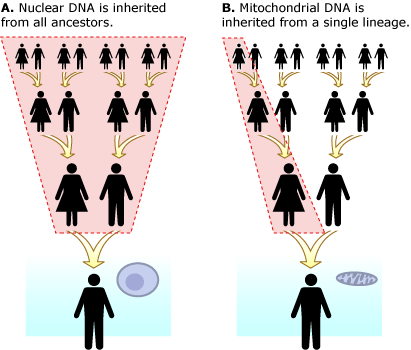
  • inherited through the female line
  • zygote contains the mitochondria of the ovum
  • mtDNA is circular so can't undergo any form of crossing over, changes in nucleotide sequence can only arise by mutation
Different human populations show differences in mitochondrial DNA sequences. This provides evidence for the origin of different populations --> 'molecular clock' hypothesis:
  • there is a constant rate of mutation over time
  • the greater the number of differences in the sequence of nucleotides, the longer ago those individuals shared a common ancestor
  • 'clock' can be estimated from fossil evidence


Extinction
Species can become extinct through a variety of mechanisms.
- climate change
- increased competition from better adapted species
- human causes:
  • loss of habitat: draining wetlands, cutting down rainforests, pollution of air, water and soil
  • killing: for sports or for food
- mass extinctions:
  • sudden change in the environment: large asteroid colliding with the Earth


17.3 Evolution

Isolating mechanisms can lead to the accumulation of different genetic information in populations, potentially leading to new species. 

Over prolonged periods of time, some species have remained virtually unchanged, others have changed significantly and many have become extinct.

a) state the general theory of evolution that organisms have changed over time 

b) discuss the molecular evidence that reveals similarities between closely related organisms with reference to mitochondrial DNA and protein sequence data 

c) explain how speciation may occur as a result of geographical separation (allopatric speciation), and ecological and behavioural separation (sympatric speciation) 

d) explain the role of pre-zygotic and post-zygotic isolating mechanisms in the evolution of new species 

e) explain why organisms become extinct, with reference to climate change, competition, habitat loss and killing by humans


Artificial selection


Humans use selective breeding (artificial selection) to improve features in ornamental plants, crop plants, domesticated animals and livestock.


- selective pressure: humans
- individuals with desirable features are chosen to interbreed = selective breeding
- some of these desirable alleles are passed onto offspring
- offspring with the most desirable features are chosen to interbreed
- this is repeated over many generations

Over many generations, alleles deemed desirable by the breeder increase in frequency, while the 'disadvantageous' ones may completely disappear over time.

Dairy cattle
- desirable features: docility, fast growth rates, high milk yield
- cows with desirable features are chosen to interbreed, and so are their offspring. This is repeated over many generations.

Bulls cannot be assessed for milk production as this is a sex-limited trait. Therefore, progeny testing is used: the performance of the bull's femail offpsirng is looked at to see whether or not to use the bull in further crosses
- background genes (alleles of genes that help an organism adapt to its particular environement) are also considered during artificial selection


Crop improvement
- Introduction of disease resistance to varieties of wheat and rice to reduce loss of yield resulting from such infections
- Incorporate mutant alleles for gibberellin synthesis into dwarf varieties --> increase proportion of energy put into each grain --> increase yield
- Inbreeding and hybridisation:

  • When maize plants are inbred, the plants in each generation become progressively smaller and weaker. This inbreeding depression occurs because, in maize, homozygous plants are less vigorous than heterozygous plants.
  • Challenge when growing maize: heterozygosity and uniformity
  • Solution: Hybridisation - cross between 2 homozygous maize varieties --> find best hybrids


17.2 Natural and artificial selection

Populations of organisms have the potential to produce large numbers of offspring, yet their numbers remain fairly constant year after year. 

Humans use selective breeding (artificial selection) to improve features in ornamental plants, crop plants, domesticated animals and livestock.

a) explain that natural selection occurs as populations have the capacity to produce many offspring that compete for resources; in the ‘struggle for existence’ only the individuals that are best adapted survive to breed and pass on their alleles to the next generation 

b) explain, with examples, how environmental factors can act as stabilising, disruptive and directional forces of natural selection 

c) explain how selection, the founder effect and genetic drift may affect allele frequencies in populations 

d) use the Hardy–Weinberg principle to calculate allele, genotype and phenotype frequencies in populations and explain situations when this principle does not apply 

e) describe how selective breeding (artificial selection) has been used to improve the milk yield of dairy cattle 

f) outline the following examples of crop improvement by selective breeding: 
• the introduction of disease resistance to varieties of wheat and rice 
• the incorporation of mutant alleles for gibberellin synthesis into dwarf varieties so increasing yield by having a greater proportion of energy put into grain 
• inbreeding and hybridisation to produce vigorous, uniform varieties of maize

Natural selection

Populations of organisms have the potential to produce large numbers of offspring, yet their numbers remain fairly constant year after year.


Natural selection occurs as populations have the capacity to produce many offsprings --> compete for resources --> individuals best adapted to survive breed and pass on their alleles.
Variation means some individuals in a population will have features which give them an advantage in the 'struggle for existence'.

Environmental factors
- biotic: caused by other organisms
    e.g.: predation, food competition, infection by pathogens
- abiotic: caused by non-living components of the environment
    e.g.: water supply, nutrient level of soil

Selection pressures control the chances of some alleles being passed on to the next generation.
    e.g.: predators - individuals that can better camouflage themselves survive more, pass on alleles
The effects of such selection pressures on the frequency of alleles in a population is called natural selection. The frequency of advantageous alleles increase, the frequency of disadvantageous alleles decrease.

Types of selection
Stabilising selection: the status quo is maintained because the organisms are already well adapted to their environment
- acts against extremes
- favours the environment
- e.g.: birth weight


Directional selection: the most common varieties of an organism are selected against --> change in the features of the population
- favours variants of 1 extreme when new allele appears or new environmental factor occurs
- e.g.: peppered moths


Disruptive selection: favours the survival of individuals at 2 different points within the range of variation, resulting in 2 different phenotypes
- conditions favour both extremes --> maintain different phenotypes in the population
- e.g.: Galapagos finches

Genetic drift
- a change in allele frequency of a small population
- occurs by chance, because only some of the organisms of each generation reproduce.
The founder effect occurs in small, isolated populations
- results from the colonization of a new location by a small number of individuals
- further genetic drift occurs in the small population
- evolution of this population may take a different direction from the larger population


The Hardy-Weinberg principle
- when a particular phenotypic trait is controlled by 2 alleles of a single gene A/a
- genotypes: AA, Aa, aa
- calculate proportion of these genotypes in a large, randomly mating population

p= frequency of dominant allele A
q = frequency of recessive allele a
Total of whole population = 1


  • chance of offspring inheriting dominant allele = px p= p2
  • chance of offspring inheriting recessive allele = qx q= q2
  • chance of inheriting both dominant and recessive allele = 2 (px q) = 2pq


17.2 Natural and artificial selection

Populations of organisms have the potential to produce large numbers of offspring, yet their numbers remain fairly constant year after year. 

Humans use selective breeding (artificial selection) to improve features in ornamental plants, crop plants, domesticated animals and livestock.

a) explain that natural selection occurs as populations have the capacity to produce many offspring that compete for resources; in the ‘struggle for existence’ only the individuals that are best adapted survive to breed and pass on their alleles to the next generation 

b) explain, with examples, how environmental factors can act as stabilising, disruptive and directional forces of natural selection 

c) explain how selection, the founder effect and genetic drift may affect allele frequencies in populations 

d) use the Hardy–Weinberg principle to calculate allele, genotype and phenotype frequencies in populations and explain situations when this principle does not apply 

e) describe how selective breeding (artificial selection) has been used to improve the milk yield of dairy cattle 

f) outline the following examples of crop improvement by selective breeding: 
• the introduction of disease resistance to varieties of wheat and rice 
• the incorporation of mutant alleles for gibberellin synthesis into dwarf varieties so increasing yield by having a greater proportion of energy put into grain 
• inbreeding and hybridisation to produce vigorous, uniform varieties of maize

Wednesday, 29 June 2016

Genetic variation

The variation that exists within a species is categorised as continuous and discontinuous. The environment has considerable influence on the expression of features that show continuous (or quantitative) variation.


Discontinuous variation
- qualitative differences
- genetic basis:
  • different alleles at a single gene locus have large effects on the phenotype
  • different genes have quite different effects on the phenotype
- e.g.: eye colour


Continuous variation
- quantitative differences
- genetic basis:
  • different alleles at a single gene locus have small effects on the phenotype
  • different genes have the same/additive effect on the phenotype
  • polygenes - large number of genes have a combined effect on a particular phenotypic trait
- e.g.: height; weight


Environmental effects on phenotype
e.g.: hair colour of Himalayan rabbits, Siamese and Burmese cats
- development of dark extremeties: tips to ears, nose, paws and tail
- caused by an allele that allows formation of dark pigments only at low temperature

e.g.: cob length of Black Mexican and Tom Thumb maize plants
- difference in light intensity and nutrients will lead to different growth of plants with the same genetic contribution
- use t-test to compare variation of the 2 different populations


Importance of genetic variation in selection - Genetic variation provides the raw material on which natural selection can act. Variation within a population means that some individuals have features that give them an advantage over other members of that population.


17.1 Variation

The variation that exists within a species is categorised as continuous and discontinuous. The environment has considerable influence on the expression of features that show continuous (or quantitative) variation.

a) describe the differences between continuous and discontinuous variation and explain the genetic basis of continuous (many, additive genes control a characteristic) and discontinuous variation (one or few genes control a characteristic) (examples from 16.2f may be used to illustrate discontinuous variation; height and mass may be used as examples of continuous variation) 

b) explain, with examples, how the environment may affect the phenotype of plants and animals 

c) use the t-test to compare the variation of two different populations (see Mathematical requirements) 

d) explain why genetic variation is important in selection


Selection and Evolution


Charles Darwin and Alfred Russel Wallace proposed a theory of natural selection to account for the evolution of species in 1858. A year later, Darwin published On the Origin of Species providing evidence for the way in which aspects of the environment act as agents of selection and determine which variants survive and which do not. The individuals best adapted to the prevailing conditions succeed in the ‘struggle for existence’. 

Candidates will be expected to use the knowledge gained in this section to solve problems in familiar and unfamiliar contexts.

Learning outcomes 

Candidates should be able to:

17.1 Variation

The variation that exists within a species is categorised as continuous and discontinuous. The environment has considerable influence on the expression of features that show continuous (or quantitative) variation.

a) describe the differences between continuous and discontinuous variation and explain the genetic basis of continuous (many, additive genes control a characteristic) and discontinuous variation (one or few genes control a characteristic) (examples from 16.2f may be used to illustrate discontinuous variation; height and mass may be used as examples of continuous variation) 

b) explain, with examples, how the environment may affect the phenotype of plants and animals 

c) use the t-test to compare the variation of two different populations (see Mathematical requirements) 

d) explain why genetic variation is important in selection

17.2 Natural and artificial selection

Populations of organisms have the potential to produce large numbers of offspring, yet their numbers remain fairly constant year after year. 

Humans use selective breeding (artificial selection) to improve features in ornamental plants, crop plants, domesticated animals and livestock.

a) explain that natural selection occurs as populations have the capacity to produce many offspring that compete for resources; in the ‘struggle for existence’ only the individuals that are best adapted survive to breed and pass on their alleles to the next generation 

b) explain, with examples, how environmental factors can act as stabilising, disruptive and directional forces of natural selection 

c) explain how selection, the founder effect and genetic drift may affect allele frequencies in populations 

d) use the Hardy–Weinberg principle to calculate allele, genotype and phenotype frequencies in populations and explain situations when this principle does not apply 

e) describe how selective breeding (artificial selection) has been used to improve the milk yield of dairy cattle 

f) outline the following examples of crop improvement by selective breeding: 
• the introduction of disease resistance to varieties of wheat and rice 
• the incorporation of mutant alleles for gibberellin synthesis into dwarf varieties so increasing yield by having a greater proportion of energy put into grain 
• inbreeding and hybridisation to produce vigorous, uniform varieties of maize

17.3 Evolution

Isolating mechanisms can lead to the accumulation of different genetic information in populations, potentially leading to new species. 

 Over prolonged periods of time, some species have remained virtually unchanged, others have changed significantly and many have become extinct.

a) state the general theory of evolution that organisms have changed over time 

b) discuss the molecular evidence that reveals similarities between closely related organisms with reference to mitochondrial DNA and protein sequence data 

c) explain how speciation may occur as a result of geographical separation (allopatric speciation), and ecological and behavioural separation (sympatric speciation) 

d) explain the role of pre-zygotic and post-zygotic isolating mechanisms in the evolution of new species 

e) explain why organisms become extinct, with reference to climate change, competition, habitat loss and killing by humans