Showing posts with label Inherited Change. Show all posts

Wednesday, 29 June 2016

Inherited change

1 Meiosis consists of two divisions. The first division, meiosis I, separates the homologous chromosomes, so that each cell now has only one of each pair. The second division, meiosis II, separates the chromatids of each chromosome. Meiotic division therefore produces four cells, each with one complete set of chromosomes.


2 Diploid organisms contain two copies of each gene in each of their cells. In sexual reproduction, gametes are formed containing one copy of each gene. Each off spring receives two copies of each gene, one from each of its parents.

3 The cells produced by meiosis are genetically different from each other and from their parent
cell. This results from independent assortment of the chromosomes as the bivalents line up on the
equator during metaphase I, and also from crossing over between the chromatids of homologous
chromosomes during prophase I.

 4 Genetic variation also results from random fertilisation, as gametes containing diff erent varieties
of genes fuse together to form a zygote.

 5 An organism’s genetic constitution is its genotype. The observable expression of its genes is its phenotype.

 6 Different varieties of a gene are called alleles. Alleles may show dominance, codominance or recessiveness. An organism possessing two identical alleles of a gene is homozygous; an organism possessing two different alleles of a gene is heterozygous. If a gene has several diff erent alleles, such as the gene for human blood groups, these are known as multiple alleles.

7 The position of a gene on a particular chromosome is its locus.

8 A gene found on the X chromosome but not on the Y chromosome is known as a sex-linked gene.

9 The genotype of an organism showing dominant characteristics can be determined by looking at the off spring produced when it is crossed with an organism showing recessive characteristics. This is called a test cross.

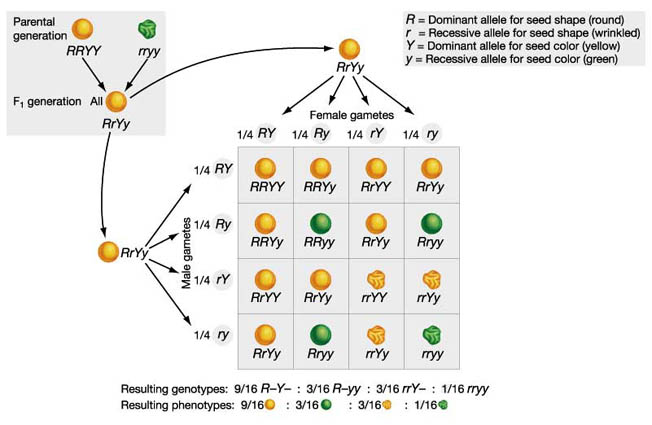
10 Monohybrid crosses consider the inheritance of one gene. Dihybrid crosses consider the inheritance of two diff erent genes.

11 The χ2 test can be used to find out whether any diff erences between expected results and observed results of a genetic cross are due to chance, or whether the difference is significant.

12 The genotype of an organism gives it the potential to show a particular characteristic. In many cases, the degree to which this characteristic is shown is also affected by the organism’s environment.

13 Mutation can be defined as an unpredictable change in the base sequence in a DNA molecule (gene mutation) or in the structure or number of chromosomes (chromosome mutation). New alleles arise by gene mutation. Gene mutations include base substitutions, deletions or additions. The HbS (sickle cell) allele arose by base substitution. Such mutations may affect the organism’s phenotype.


1. End-of-chapter questions

1. A cell in the process of meiosis was seen to have a spindle with sister chromatids being drawn  towards opposite poles of the cell. In what stage of meiosis was the cell?                           .
  A  anaphase I
  B  anaphase II
  C metaphase I
  D metaphase II

2  All the offspring of a cross between pure-bred  red-flowered and pure-bred white-flowered                   snapdragons were pink.

Two of these pink-flowered plants were interbred.  What proportion of the offspring were pink?
   A  25%
   B  33%
   C  50%
   D  100%

3  A man has haemophilia.  Which  statement correctly describes the inheritance  of the gene causing his condition?

   A  He inherited  the recessive allele from his mother.
   B  He inherited  the dominant  allele from his father.
   C  He can pass the recessive allele to a son.
   D He can pass the dominant  allele to a daughter.


4   The  diploid  (2n) chromosome  number of  Drosophila is 8. Copy and complete the table to show  the different outcome of mitotic and meiotic division of a Drosophila cell.


5  Copy and complete the table to compare meiosis with mitosis.


6    a    Describe the essential  difference between meiosis I and meiosis  II. 
      b    State the similarity between meiosis II and  mitosis.

7   There is no crossing over during meiosis in male Drosophila. Assuming that no mutation occurs,   the only source of genetic variation is independent assortment. Given that the diploid (2n) chromosome  number is 8, calculate the number of genetically different spermatozoa that can be produced.

8    Distinguish between the following pairs of terms. 
    a genotype and  phenotype
    b  homozygous and heterozygous

9  In sweet-pea plants, the gene A/a controls flower colour. The dominant allele gives purple flowers  and the recessive allele red flowers.

A second gene, B/b, controls the shape of the pollen grains.  The dominant allele gives elongated   grains and the recessive allele spherical grains.

A plant with  the genotype AaBb  was  test-crossed by interbreeding it with a plant with red flowers and spherical pollen grains.

Copy and complete the table to show that the expected ratio of phenotypes of the offspring of this cross. The gametes from one parent are already in the table.

[5]

10  a  The fruit fly, Drosophila melanogaster, feeds on sugars found  in damaged fruits. A fly with   normal features is called a wild  type. It has a striped body and its wings are longer than  its abdomen. There are mutant variations such as an ebony-coloured body or vestigial wings. These three types of fly are shown in the figure.


Wild-type  features are coded for by dominant alleles:  A for wild-type body and B for wild-type    wings. Explain what is meant by the terms allele and dominant. [2]

b   Two wild-type  fruit flies were  crossed.  Each had alleles A and  B and carried alleles for ebony   body and vestigial  wings.

Draw a genetic diagram to show the possible offspring of this cross.   [6]

c  When the two heterozygote flies in b were crossed, 384 eggs hatched and developed into adult   flies.
A chi-squared (X2)  test  was  carried out to test the significance of the differences between  observed   and expected results:


i  Copy and complete the table.


  [1]
ii Calculate the value for X2
The  table  below  relates X2 values to probability values.
As four classes of data were counted,  the number of degrees of freedom was 4 - 1 = 3. The table  gives values of X2 where there are three degrees of freedom.


iii Using  your  value  for  X2  and  the table above, explain whether or not the observed results were  significantly different from the expected results.                                     [2]
[Total: 14]

[Cambridge International  AS and A Level Biology 9700/41, Question 7, October/November2009]


2. End-of-chapter answers
1 B
2 C
3 A

6 a meiosis I: separates homologous chromosomes; 
      meiosis II: separates sister chromatids; 
   b both separate sister chromatids; 

7 (2n , where n = 4) 2 × 2 × 2 × 2 = 16 

8 a genotype: the genetic constitution of an organism with respect to a gene or genes; 
     phenotype: the physical, detectable expression of the particular alleles of a gene or genes present in an individual; 

  b homozygous: describes a diploid organism that has the same allele of a gene at the gene’s locus on both copies of the homologous chromosome; 
     heterozygous: describes a diploid organism that has diff erent alleles of a gene at the gene’s locus on the homologous chromosomes;

Exam-style questions


Gene control in eukaryotes

Some genes are transcribed all the time to produce constituitive proteins; others are only 'switched on' when their protein products are required.


Transcription factors bind to the promoter region of a gene. This may increase or decrease the transcription of the gene. Their roles are to make sure that genes are expressed in the correct cell at the correct time and to the correct extent.

Effects of transcription factors:

  • form part of the protein complex that binds to the promoter region of the gene
  • activate appropriate genes in sequence
  • determination of sex in animals
  • allow responses to environmental stimuli
  • regulate cell cycle, growth and apoptosis
  • give hormones their effect

Gibberellin (a plant hormone) controls seed germination in plants such as wheat and barley by stimulating the synthesis of amylase. 

- DELLA protein inhibits the binding of a transcription factor to the gene promoter PIF 
- gibberellin causes the breakdown of DELLA protein
- gibberellin allows PIF to bind to its target promoter 
- transcription of the gene can take place
- increases amylase production


16.3 Gene control 

Some genes are transcribed all the time to produce constitutive proteins; others are only ‘switched on’ when their protein products are required. 

a) distinguish between structural and regulatory genes and between repressible and inducible enzymes 

b) explain genetic control of protein production in a prokaryote using the lac operon 

c) explain the function of transcription factors in gene expression in eukaryotes 

d) explain how gibberellin activates genes by causing the breakdown of DELLA protein repressors, which normally inhibit factors that promote transcription

Tuesday, 28 June 2016

Gene control in prokaryotes (lac operon)


In both prokaryotes and eukaryotes, transcription of a gene is controlled by transcription factors.


Transcription factors are:

  • proteins that bind to a specific DNA sequence
  • control the formation of mRNA --> control the flow of information from DNA to RNA 

Structural genes code for proteins required by a cell.
Regulatory genes code for proteins that regulate the expression of other genes.

The synthesis of repressible enzymes can be prevented by binding a repressor protein to the operator (a specific site) on the bacterium's DNA.
The synthesis of inducible enzymes occur when its substrate is present.

Prokaryotic lac operon

operon: a length of DNA making up a unit of gene expression in a bacterium.

The lac operon consists of a length of DNA with operator and promoter regions and a cluster of 3 structural genes:
  • lacZ - coding for β-galactosidase (hydrolyses lactose to glucose + galactose)
  • lacY - coding for permease (allows lactose to enter cell)
  • lacA - coding for transacetylase
Close to the promoter, although not part of the operon, is the regulatory gene for the lac operon.

Lactose absent
  • regulatory gene codes for repressor protein*
  • repressor binds to operator region, close to lacZ
  • RNA polymerase can't bind to DNA at promoter region
  • no transcription of the 3 structural genes
*repressor protein is allosteric (has 2 binding sites). The repressor binds to DNA with one site and binds to lactose with another site. 

Lactose present:
  • lactose taken up by bacterium
  • lactose binds to repressor protein, distorts shape and prevents it from binding to the operator region on the DNA (closes DNA-binding site)
  • transcription no longer inhibited
  • mRNA produced from 3 structural genes
This makes sure that the bacterium can produce β-galactosidase, permease and transacetylase only when lactose is available in the surrounding medium. This avoids waste of energy and materials.


Question 10a from 2016 specimen paper


http://papers.gceguide.com/A%20Levels/Biology%20(9700)/9700_y16_sp_4.pdf
http://papers.gceguide.com/A%20Levels/Biology%20(9700)/9700_y16_sm_4.pdf


16.3 Gene control 

Some genes are transcribed all the time to produce constitutive proteins; others are only ‘switched on’ when their protein products are required. 

a) distinguish between structural and regulatory genes and between repressible and inducible enzymes 

b) explain genetic control of protein production in a prokaryote using the lac operon 

c) explain the function of transcription factors in gene expression in eukaryotes 


d) explain how gibberellin activates genes by causing the breakdown of DELLA protein repressors, which normally inhibit factors that promote transcription

Monday, 27 June 2016

Genetic mutations

A mutation is an unpredictable change in the genetic material of an organism.


Gene mutation: change in the structure of a DNA molecule, producing a different allele of a gene.
Chromosome mutation: changes in the structure or number of whole chromosomes in a cell.

Sources/ mutagens : increase chances of a mutation occuring
- random
- environmental factors (ionising radiations alpha, beta, gamma; UV radiation; chemicals)

Gene mutations
Types:

  • base substitution
  • base addition
  • base deletion
Consequences:
  • silent: same amino acid; a mutation that has no apparent effect on the organism 
  • missense: different amino acid; no apparent effect
  • nonsense: introduce a 'stop' triplet
  • frame shift: protein that is made becomes totally useless


Base additions and deletions usually have a very significant effect on the structure and therefore the function of the polypeptide that the allele codes for.


1. Sickle cell anaemia

Base substitution in the gene that codes for the amino acid sequence in the β-globin
Glutamic acid --> valine; HbA allele --> HbS allele
Effects: Haemoglobin molecule becomes much less soluble 
  • molecules stick together and form long fibres inside red blood cells 
  • rbc are pulled out of shape, into a half-moon or sickle shape
  • distorted cells become stuck in small capillaries and so cannot transport oxygen, block normal rbcs getting through


2. Albinism

- Classic form - Autosomal recessive mutation: individuals that are homozygous for the recessive allele show albinism
- Other forms - mutation at several loci; sex-linked
Mutation in the gene for tyrosinase:
  • absence of tyrosinase
  • presence of inactive tyrosinase
Effects:
  • dark pigment melanin partially/totally missing from eyes, skin or hair
  • poor vision; rapid, jerky eye movement; avoids bright light

3. Huntington's disease:

Mutation inherited as a dominant allele. The mutation is an unstable segment in a gene on chromosome 4 coding for a protein called huntingtin. 
  • Non-sufferers: small number of repeats of the triplet of bases CAG
  • Sufferer: 'stutter' - larger number of CAG repeats CAG CAG CAG CAG CAG CAG CAG 
Effects: 
  • HD is a neurological disorder resulting in involuntary movements (chorea) and progressive mental deterioration. 
  • The age of onset is variable, but occurs most commonly in middle age.
  • The more CAG stutters, the earlier the age of onset.

4. Haemophilia

- Mutation is sex-linked (gene on the X chromosome)
- Gene codes for the production of protein for blood-clotting 'factor VIII'
  • H: dominant allele
  • h: recessive allele - blood fails to clot properly


16.2 The roles of genes in determining the phenotype 

Patterns of inheritance are explained by using genetic diagrams. The results of genetic crosses are analysed statistically using the chisquared test. 

Studies of human genetic conditions have revealed the links between genes, enzymes and the phenotype. 

a) explain the terms gene, locus, allele, dominant, recessive, codominant, linkage, test cross, F1 and F2, phenotype, genotype, homozygous and heterozygous 

b) use genetic diagrams to solve problems involving monohybrid and dihybrid crosses, including those involving autosomal linkage, sex linkage, codominance, multiple alleles and gene interactions (the term epistasis does not need to be used; knowledge of the expected ratio for various types of epistasis is not required. The focus is on problem solving) 

c) use genetic diagrams to solve problems involving test crosses 

d) use the chi-squared test to test the significance of differences between observed and expected results (the formula for the chi-squared test will be provided) (see Mathematical requirements) 

e) explain that gene mutation occurs by substitution, deletion and insertion of base pairs in DNA and outline how such mutations may affect the phenotype 

f) outline the effects of mutant alleles on the phenotype in the following human conditions: albinism, sickle cell anaemia, haemophilia and Huntington’s disease 


g) explain the relationship between genes, enzymes and phenotype with respect to the gene for tyrosinase that is involved with the production of melanin

Sunday, 26 June 2016

Genetic diagrams

Patterns of inheritance are explained by using genetic diagrams. Genetic diagrams are the standard way of showing the genotypes of offspring that might be expected from 2 parents.


In sexual reproduction, haploid gametes are made following meiosis. Each gamete contains 1 pair or chromosomes = one copy of each gene.

Monohybrid inheritance: inheritance of 1 gene


Codominance: alleles both have an effect on the phenotype of a heterozygous organism.


Multiple alleles: As the name suggests, when a gene has more than 2 alleles


Sex linkage - a sex linked gene is a gene that is present on the X chromosome and not the Y chromosome
e.g.: colour blindness


Dihybrid inheritance: inheritance of 2 genes
Independent assortment of homologous chromosomes during meiosis I results in a variety of genotypes in the gametes formed.


ratio    9 : 3 : 3 : 1 of dihybrid cross between 2 heterozygotes

  • alleles of both genes show complete dominance
  • genes are on different chromosomes 


Interactions between loci - where different loci interact to affect one phenotypic character
e.g.: alleles on 2 separate loci both affect the colour of feathers on a bird

Autosomal linkage
Genes are linked when two or more genes are present on the same chromosome => they tend to be inherited together and do not assort independently.

e.g.: Drosophila colour gene and shape gene
Body colour gene:

  • E = allele for striped body
  • e = allele for ebony body
Antennal shape gene:
  • A = allele for normal antennae
  • a = allele for aristopedia antennae
EEAA = genes not on same chromosome
(EA)(EA) = genes on the same chromosome
  • Parental genotype (EA)(EA) => gametes EA only
  • Parental genotype (EA)(ea) => gametes EA or ea
  • Parental genotype (ea)(ea) => gametes ea only


16.2 The roles of genes in determining the phenotype 

Patterns of inheritance are explained by using genetic diagrams. The results of genetic crosses are analysed statistically using the chisquared test. 

Studies of human genetic conditions have revealed the links between genes, enzymes and the phenotype. 

a) explain the terms gene, locus, allele, dominant, recessive, codominant, linkage, test cross, F1 and F2, phenotype, genotype, homozygous and heterozygous 

b) use genetic diagrams to solve problems involving monohybrid and dihybrid crosses, including those involving autosomal linkage, sex linkage, codominance, multiple alleles and gene interactions (the term epistasis does not need to be used; knowledge of the expected ratio for various types of epistasis is not required. The focus is on problem solving) 

c) use genetic diagrams to solve problems involving test crosses 


d) use the chi-squared test to test the significance of differences between observed and expected results (the formula for the chi-squared test will be provided) (see Mathematical requirements) 

e) explain that gene mutation occurs by substitution, deletion and insertion of base pairs in DNA and outline how such mutations may affect the phenotype 

f) outline the effects of mutant alleles on the phenotype in the following human conditions: albinism, sickle cell anaemia, haemophilia and Huntington’s disease 

g) explain the relationship between genes, enzymes and phenotype with respect to the gene for tyrosinase that is involved with the production of melanin

Monday, 20 June 2016

Terms for human genetics

Studies of human genetic conditions have revealed the links between genes, enzymes and the phenotypes.


  • gene: length of DNA that codes for a particular protein/polypeptide
  • locus: position at which a particular gene is found on a particular chromosome; same gene on same locus
  • allele: particular variety of a gene

  • dominant: the allele whose effect on the phenotype of a heterozygote is identical to its effect on a homozygote
  • recessive: the allele that is only expressed when no dominant allele is present
  • codominant: alleles that both have an effect on the phenotype of a heterozygous organism
  • linkage: the presence of 2 genes on the same chromosome so that they tend to be inherited together and do not assort independently

  • test cross: a genetic cross in which an organsim showing a characteristic caused by a dominant allele is corssed with an organism that is homozygous recessive --> phenotype of offspring is a guide to whether the 1st organism is homozygous or heterozygous
  • F1: generation of offspring produced from homozygous dominant x homozygous recessive genotype
  • F2: generation of offspring produced from cross between 2 F1 organisms


  • phenotype: organisms' characteristics; often resulting from an interaction between its genotype and the environment
  • genotype: alleles possessed by an organism

  • homozygous: having 2 identical alleles of a gene
  • heterozygous: having 2 different alleles of a gene


16.2 The roles of genes in determining the phenotype 

Patterns of inheritance are explained by using genetic diagrams. The results of genetic crosses are analysed statistically using the chisquared test. 

Studies of human genetic conditions have revealed the links between genes, enzymes and the phenotype. 

a) explain the terms gene, locus, allele, dominant, recessive, codominant, linkage, test cross, F1 and F2, phenotype, genotype, homozygous and heterozygous 

b) use genetic diagrams to solve problems involving monohybrid and dihybrid crosses, including those involving autosomal linkage, sex linkage, codominance, multiple alleles and gene interactions (the term epistasis does not need to be used; knowledge of the expected ratio for various types of epistasis is not required. The focus is on problem solving) 

c) use genetic diagrams to solve problems involving test crosses 

d) use the chi-squared test to test the significance of differences between observed and expected results (the formula for the chi-squared test will be provided) (see Mathematical requirements) 

e) explain that gene mutation occurs by substitution, deletion and insertion of base pairs in DNA and outline how such mutations may affect the phenotype 

f) outline the effects of mutant alleles on the phenotype in the following human conditions: albinism, sickle cell anaemia, haemophilia and Huntington’s disease 

g) explain the relationship between genes, enzymes and phenotype with respect to the gene for tyrosinase that is involved with the production of melanin

Meiosis

Meiosis involves two divisions, called meiosis I and meiosis II.


Meiosis I:

  • reduction division 
  • resulting in 2 daughter nuclei (haploid)  half the number of chromosomes of the parent nucleus

Meiosis II:

  • behaves like mitosis
  • results in total of 4 haploid nuclei

Meiosis I
1. Prophase I
  • centrosomes divide and move to opposite poles of nucleus --> spindle formation
  • homologous chromosomes pair up --> crossing over and form bivalents
  • nucleus disappears
  • nuclear envelope breaks down
2. Metaphase I
  • bivalents line up at equator
  • spindles attach to centromere
3. Anaphase I
  • whole chromosomes move to opposite poles of spindle
  • pulled by microtubules
4. Telophase I
  • nuclear envelope reforms
  • nucleolus reform


Meiosis II
5. Prophase II
  • nuclear envelope breaks down
  • nucleolus disappears
  • centrosomes and centrioles replicate; move to opposite poles

6. Metaphase II
  • chromosomes line up separately across equator of spindle

7. Anaphase II
  • centromeres divide
  • spindle microtubules pull chromatids to opposite poles

8. Telophase II
  • 4 haploid daughter cells


How meiosis causes variation
Crossing over:
  • prophase of meoisis I
  • chromatids of 2 homologous chromosomes break and rejoin --> part of one chromatid swaps places with the same part of the other (exchange of gene loci between a maternal and paternal chromatid)
  • chiasmata: point where crossing over occurs
Recombinant organisms result from crossing over and so 'recombines' the characteristics of the parent organisms. The cross over value is the percentage of offspring that belong to the recombinant class.

Independent assortment: 
  • random alignment of bivalents on the equator during meiosis I
  • different alleles of genes on different chromosomes may end up in any combination in gametes


16.1 Passage of information from parent to offspring 

Diploid organisms contain pairs of homologous chromosomes. The behaviour of maternal and paternal chromosomes during meiosis generates much variation amongst individuals of the next generation. 

a) explain what is meant by homologous pairs of chromosomes 

b) explain the meanings of the terms haploid and diploid and the need for a reduction division (meiosis) prior to fertilisation in sexual reproduction 

c) outline the role of meiosis in gametogenesis in humans and in the formation of pollen grains and embryo sacs in flowering plants 

d) describe, with the aid of photomicrographs and diagrams, the behaviour of chromosomes in plant and animal cells during meiosis, and the associated behaviour of the nuclear envelope, cell surface membrane and the spindle (names of the main stages are expected, but not the sub-divisions of prophase) 

e) explain how crossing over and random assortment of homologous chromosomes during meiosis and random fusion of gametes at fertilisation lead to genetic variation including the expression of rare, recessive alleles


Gametogenesis

Diploid organisms contain pairs of homologous chromosomes.


Homologous chromosomes:

  • a pair of chromosomes in a diploid cell
  • same structure, genes, loci
  • pair together to form bivalent during the first division of meiosis

Haploid: possesses 1 complete set of chromosomes: n
Diploid: possesses 2 complete sets of chromosomes: 2n
Meiosis: reduction division
  • number of chromosomes would double without meiosis
  • introduces genetic variation à mutation

Gametogenesis in mammals


Gametogenesis in plants

Development of pollen grain


Development of embryo sac


16.1 Passage of information from parent to offspring 

Diploid organisms contain pairs of homologous chromosomes. The behaviour of maternal and paternal chromosomes during meiosis generates much variation amongst individuals of the next generation. 

a) explain what is meant by homologous pairs of chromosomes 

b) explain the meanings of the terms haploid and diploid and the need for a reduction division (meiosis) prior to fertilisation in sexual reproduction 

c) outline the role of meiosis in gametogenesis in humans and in the formation of pollen grains and embryo sacs in flowering plants 

d) describe, with the aid of photomicrographs and diagrams, the behaviour of chromosomes in plant and animal cells during meiosis, and the associated behaviour of the nuclear envelope, cell surface membrane and the spindle (names of the main stages are expected, but not the sub-divisions of prophase) 

e) explain how crossing over and random assortment of homologous chromosomes during meiosis and random fusion of gametes at fertilisation lead to genetic variation including the expression of rare, recessive alleles


Sunday, 19 June 2016

Inherited Change


Genetic information is transmitted from generation to generation to maintain the continuity of life. In sexual reproduction, meiosis introduces genetic variation so that offspring resemble their parents but are not identical to them. Genetic crosses reveal how some features are inherited. The phenotype of organisms is determined partly by the genes they have inherited and partly by the effect of the environment. Genes determine how organisms develop and gene control in bacteria gives us a glimpse of this process in action. 

Candidates will be expected to use the knowledge gained in this section to solve problems in familiar and unfamiliar contexts.

Learning outcomes

Candidates should  be able to:

16.1 Passage of information from parent to offspring 

Diploid organisms contain pairs of homologous chromosomes. The behaviour of maternal and paternal chromosomes during meiosis generates much variation amongst individuals of the next generation. 

a) explain what is meant by homologous pairs of chromosomes 

b) explain the meanings of the terms haploid and diploid and the need for a reduction division (meiosis) prior to fertilisation in sexual reproduction 

c) outline the role of meiosis in gametogenesis in humans and in the formation of pollen grains and embryo sacs in flowering plants 

d) describe, with the aid of photomicrographs and diagrams, the behaviour of chromosomes in plant and animal cells during meiosis, and the associated behaviour of the nuclear envelope, cell surface membrane and the spindle (names of the main stages are expected, but not the sub-divisions of prophase) 

e) explain how crossing over and random assortment of homologous chromosomes during meiosis and random fusion of gametes at fertilisation lead to genetic variation including the expression of rare, recessive alleles

16.2 The roles of genes in determining the phenotype 

Patterns of inheritance are explained by using genetic diagrams. The results of genetic crosses are analysed statistically using the chisquared test. 

Studies of human genetic conditions have revealed the links between genes, enzymes and the phenotype. 

a) explain the terms gene, locus, allele, dominant, recessive, codominant, linkage, test cross, F1 and F2, phenotype, genotype, homozygous and heterozygous 

b) use genetic diagrams to solve problems involving monohybrid and dihybrid crosses, including those involving autosomal linkage, sex linkage, codominance, multiple alleles and gene interactions (the term epistasis does not need to be used; knowledge of the expected ratio for various types of epistasis is not required. The focus is on problem solving) 

c) use genetic diagrams to solve problems involving test crosses 

d) use the chi-squared test to test the significance of differences between observed and expected results (the formula for the chi-squared test will be provided) (see Mathematical requirements) e) explain that gene mutation occurs by substitution, deletion and insertion of base pairs in DNA and outline how such mutations may affect the phenotype 

f) outline the effects of mutant alleles on the phenotype in the following human conditions: albinism, sickle cell anaemia, haemophilia and Huntington’s disease 

g) explain the relationship between genes, enzymes and phenotype with respect to the gene for tyrosinase that is involved with the production of melanin

16.3 Gene control 

Some genes are transcribed all the time to produce constitutive proteins; others are only ‘switched on’ when their protein products are required. 

a) distinguish between structural and regulatory genes and between repressible and inducible enzymes 

b) explain genetic control of protein production in a prokaryote using the lac operon 

c) explain the function of transcription factors in gene expression in eukaryotes 

d) explain how gibberellin activates genes by causing the breakdown of DELLA protein repressors, which normally inhibit factors that promote transcription