Showing posts with label health plans. Show all posts

Saturday, 26 March 2016

Who Should be Seen as a "Healthcare Executive" and Why Does it Matter?

The American College of Healthcare Executives (ACHE) has as its vision "To be the premier professional society for healthcare executives dedicated to improving healthcare delivery." ACHE's excellent 2015 statement - Creating an Ethical Culture Within the Healthcare Organization - rests on an assertion I wholeheartedly support: namely, that "all healthcare executives have a professional obligation to create an ethical culture." (I added the emphasis)

If you agree with the ACHE assertion, and I'm prepared to go to the mat for it, the first question is: what counts as a "healthcare executive"? How wide is the scope of the term?

Clearly, executives at hospitals, medical groups, and other organizations that deal directly with patients carry major moral responsibilities. After all, health care is crucial for realizing all three of the "unalienable rights" put forward in the Declaration of Independence: life (sometimes health care saves our lives), liberty (we can't exercise our freedom without health), and pursuit of happiness (we can be happy without health, but it's more difficult, and severe enough pain makes it impossible).

ACHE deliberately leaves the scope of the term vague. It defines itself an an organization for "healthcare executives who lead hospitals, healthcare systems and other healthcare organizations." From my experience as a physician, administrator, and patient, I'd cast a wide net for defining "other healthcare organizations" and setting ethical expectations for them.

In the complex U.S. health system direct care organizations aren't the only important moral agents. Health plans and pharmaceutical companies are perhaps the two most important examples of indirect moral agents.

Over the years I've tried to encourage health plans to create ethics programs the way Harvard Pilgrim Health Care, where I have directed the ethics program for sixteen years, has done. I've had zero success. This doesn't mean that other health plans are unethical, but it does suggest that ethical performance is not seen as something that requires the kind of concerted leadership the ACHE statement on responsibility for creating an ethical culture calls for. (For a previous post about my quixotic efforts, see here.)

Executives in the pharmaceutical industry face especially difficult challenges in relation to the kinds of expectations the ACHE standards articulate. They're clearly crucial participants in  the sacred calling of health care. At the same time, they're embedded in a highly competitive industry with strong profit demands. Pharmaceutical executives work in the jaws of a severe dual agency challenge: sacred calling vs the invisible hand of the market.

More than forty years ago, Arnold Relman warned of the potentially disruptive moral impact of what he called "The New Medical-Industrial Complex." Since his prescient warning there have been efforts to establish a shared moral code for all participants in the world of health care. A distinguished U.S. and U.K. group articulated the "Tavistock Principles," but these, alas, seem to have been dead on arrival, and have not been heard from for fifteen years. And for a number of years the American Medical Association sponsored an "Ethical Force" program that sought to establish measurable ethical standards for the major players in the health sector. I had the privilege of being on the advisory panel on health benefits determination. The project produced some excellent materials and a book, but as with the Tavistock principles, the effort was relatively short-lived.

When I mulled over how to end this post I realized that I don't have a tidy upbeat ending. The image that came to mind was of Sisyphus, eternally pushing a rock up the hill. It seems to me that Arnold Relman's call to action points to an ongoing task captured in this cartoon:


I'll do more rock pushing in future posts!

Friday, 18 March 2016

Insurance Coverage for Telemedicine

Last week the Harvard Pilgrim Ethics Advisory Group (EAG) devoted its quarterly meeting to the topic of "Developing a Framework of Ethics for Telemedicine." I chair the group and write a consultation report based on the discussion. Four of the group's recommendations are relevant for all health insurers and health plans, so I'm presenting them here:

  1.  Nationally, telemedicine is evolving rapidly in a somewhat helter-skelter manner. The EAG recommended that insurers should focus coverage on areas in which telemedicine can minister to significant health needs. Fitbit and other health trackers are popular with consumers but do not reflect the kind of “need” that health insurance should cover. In contrast, services for patients who cannot access important care because of geography or limited mobility and services that maintain or improve quality while reducing costs provide real value.
  2.  Patients and physicians both see continuity of care as a crucial health care value. But patients also value access and convenience, which have driven the uptake of telemedicine. Ideally, insurers will find ways to reconcile these potentially conflicting values, as by requiring telemedicine providers to foster communication with the patient’s primary care physician if the patient gives permission. The group imagined technological “fixes” that would encourage patients to be active participants in establishing continuity of care, as by having the telemedicine provider’s note go to the patient, to be shared with whomever the patient wishes to inform. 
  3.  One of the questions the EAG had been asked was: "Should Harvard Pilgrim be a leader in providing telemedicine coverage or wait for well established quality information and support from the relevant professional organizations prior to offering access?" The group saw the question as too either/or. Telemedicine is at once (a) a promising innovation that is (b) energized by societal trends in use of technology in other sectors of life, but (c) uncertain in its impact on cost and quality of care. It encouraged Harvard Pilgrim to be active in the area of telemedicine, but do so in a try it/evaluate it/fix it/or drop it manner, in order to learn from experience and contribute to knowledge about the emerging trend.
  4.   A Google search for "telemedicine providers" brings up a dizzying array of links. There is a lot of money to be made, and the marketplace is in a feeding frenzy. Given the certainty that consumers will be exposed to services ranging from high quality/high value enterprises to bottom feeders hoping to take the money and run, the EAG recommended that insurers only cover services from vendors who share and apply the same values with regard to improving quality, reducing overall costs, and supporting continuity of care. This revenue prediction table illustrates why the marketplace offers patients both promise and risk: 

  5. SKYROCKETING REVENUE PREDICTIONS FOR TELEMEDICINE!

To learn more about the Harvard Pilgrim Health Care ethics program, see previous blog posts here and here, and this article in Health Affairs


Friday, 29 March 2013

A Personal Experience with Medical Cost Containment

When I saw my primary care physician earlier this week he gave me a pep talk about scheduling the colonoscopy I'd been dawdling on doing. I decided it was time to follow his advice.

I had two reasons for being concerned about how much the colonoscopy would cost. First, from the self-centered perspective, my insurance includes a $1500 deductible, so I would be paying some or all of the cost on my own nickel. Second, from the perspective of a concerned citizen, I believe we all have a moral responsibility to (a) take care of our health (b) at the lowest cost to collective insurance funds. If the test cost more than my deductible my fellow insurees will be paying for my charges, and I should consider their financial well-being just as I consider my own.

I'd recently received notice that my self-insured employer offers a service called SaveOn, provided by Tandem Care, a five year old New Hampshire company that gives patients comparative cost information on services within their insurance network. If we're already scheduled to go to a "low cost" provider, we get a $10 reward simply for having called the SaveOn program. If we're scheduled for a high cost provider and choose to go to a lower cost provider instead, we get a reward of $25 to $75, depending on the cost of the procedure.

I receive my care from Harvard Vanguard Medical Associates, a large non-profit, multi-specialty group practice in Massachusetts. I preferred to have the colonoscopy done at the HVMA facility. Doing so would ensure the best coordination of information flow and followup. But suppose an alternative of good enough quality cost $500 less? Would coordination be worth that much additional cost to me?

I called the SaveOn service with some trepidation. The service itself was excellent. A nurse answered my call after one ring. She took my information efficiently and called me back within 15 minutes. Happily, the site I'd been referred to within the group practice was considered a "low cost provider." That spared me the challenge of (a) deciding how much additional cost continuity of care was worth to me and (b) chiding my medical team for being "high cost." The SaveOn nurse told me I'd receive a $10 check after the procedure was done.

Within the cockamamie U.S. health "system," Tandem Care/SaveOn are providing a valuable service. In our consumer role it helps us take care of ourselves at a lower cost. Even if our insurance does not include a deductible - something that is increasingly rare nowadays - the reward for choosing a lower cost provider is enough to matter to us. In our citizen role the program helps us reduce overall costs to the body politic, and, at the same time, educates us to think about costs in health care as we do in virtually every other aspect of our lives.

For decades, we in the U.S. have been searching desperately for ways to make health care less costly. None of the gimmicks we try will work unless we citizens embrace the effort. If we had a national system with a budget paid for via our taxes the way most other developed countries do we'd be invested in getting the most bang for our bucks. But in the highly fragmented "system" we have, the relationship between overall costs and the choices we make as individuals is largely invisible to us. My little experience with SaveOn shows how smart systems can help to make us less stupid about costs!

Wednesday, 6 February 2013

Nonprofit Regional Health Plans

As the US health system moves towards the 2014 launching of health exchanges and other components of Obamacare, regional nonprofit health plans are poised to take a distinctively important role.

An article in today's New York Times described the steps Florida Blue, which covers 4 million Floridians - 30 percent of the Florida insurance market - is taking. The  proposal for a "public option" like Medicare for all that would compete with private insurers crashed and burned in the health reform process, but regional nonprofits like Florida Blue are carrying out the function that was envisioned for the public option. Nonprofits can't function without making a margin beyond their expenses, but their structure allows them to be more mission-driven and locally connected than investor-owned plans.

For much of my clinical career I practiced at the nonprofit Harvard Community Health Plan (HCHP) HMO. My late father, who lived in Florida, know how much I respected HCHP, and asked me if he should join an HMO. At that time none of his choices were nonprofits, and I'd read about various scandals in the Florida market. If he'd been living in Massachusetts I would have encouraged him to join HCHP where I and my family got our care, but I advised him against the HMO route in Florida.

Medical care is ultimately local. It works best when clinicians and their organizations are part of the local community. This passage in the article stood out for me:
“Florida Blue has the same problems everyone else has,” said Dr. Michael A. Wasylik, an orthopedic surgeon in Tampa who works with insurers through the Florida Medical Association, but “they have a better trust relationship with doctors.” The local representatives are better able to address doctors’ concerns, he said.
Health reform won't get anywhere without enthusiastic participation from the clinical community. Insurers can facilitate reform, but they can't make it happen. Engagement with the local community, and above all the kind of trust that Dr. Wasylik refers to, are key. If the national for-profit giants can compete successfully with regional nonprofits like Florida Blue, more power to them. But if the narrow margins and need for highly collaborative relationships with the clinical community make Obamacare an undesirable business opportunity, regional nonprofits like Florida Blue will flourish.

Friday, 16 March 2012

Goldman Sachs, Corporate Culture, and Medical Ethics

When Greg Smith, an executive director at Goldman Sachs, and head of the firm's US equity derivatives business in Europe, the Middle East, and Africa, explained why he resigned from the company in a remarkable New York Times op ed piece two days ago, the story went viral. Here's the essence of what he had to say:
After almost 12 years at the firm...I believe I have worked here long enough to understand the trajectory of its culture, its people, and its identity. And I can honestly say the environment now is as toxic and destructive as I have ever seen it....I have always taken a lot of pride in advising my clients to do what I believe is right for them, even if it means less money for the firm. This view is becoming increasingly unpopular at Goldman Sachs...I attend derivatives sales meeting where not one single minute is spent asking questions about how we can help clients. It's purely about how we can make the most possible money off of them. If you were an alien from Mars and sat in on one of these meetings, you would believe that a client's success or progress was not part of the thought process at all.
Years ago, my friend Marc Bard, a brilliant consultant, taught me the aphorism - "culture beats strategy every time." This is perhaps especially true in health care, which is so strongly mission-driven. If the shared culture of a health organization is truly patient centered every action will express the organization's values.

I experienced how culture works especially clearly 19 years ago, when my father, near the end of his life, was a patient at the Lahey Clinic. In my distracted and distressed state, I locked my keys in my car. I went to the building services office to get help. A staff member (a) picked the car's lock with expertise, but also (b) conducted excellent common sense psychotherapy with me around how we get forgetful when we're upset, and (c) said he would pray for my father. Remembering the incident and writing about it here brought tears back to my eyes. I'm happy that I wrote to the CEO to report on the excellent care I received from his non-clinical staff and to congratulate him on the culture of the organization.

I'm lucky that the four health organizations I've been part of during my career - the Massachusetts Mental Health Center, Harvard Community Health Plan/Harvard Vanguard Medical Associates (HCHP morphed into HVMA), the Harvard Pilgrim Health Care insurance company, and the Harvard Pilgrim Health Care Institute,  have all had cultures and evinced values I've been proud to be associated with. I doubt, however, that the people at those organizations were intrinsically more ethical than the colleagues Greg Smith is writing about.

When one's colleagues and the leaders of an organization share core values they reinforce each other. Newcomers are selected for fit with the culture, and the culture (what educators call the "hidden curriculum") brings out the best in us. It's easier for a health organization than for Goldman Sachs to cultivate a positive culture because the mission of caring for people who are suffering encourages empathy. I'd like to believe that I'd leave as Greg Smith did if I found myself part of an organization with a environment that is "toxic and destructive" and was unable to influence it, but knowing the human capacity for self-delusion, I can't be smug and certain that I wouldn't follow the same playbook Greg Smith discerned at Goldman Sachs.

Aristotle conceptualized "character" as an inner state or way of being that shows itself in the patterns of our actions. "Culture" is the organizational equivalent of "character." Culture is partly formed by the characters of those who constitute it, but the influence goes both ways. In trying to understand our human natures, we need to consider "culture" and "character" along with "nature" and "nurture."

Friday, 4 November 2011

Union Health Plans and Health System Ethics

On November 1 I blogged about how much I looked forward to meeting the next day with union leaders responsible for overseeing union health plans.

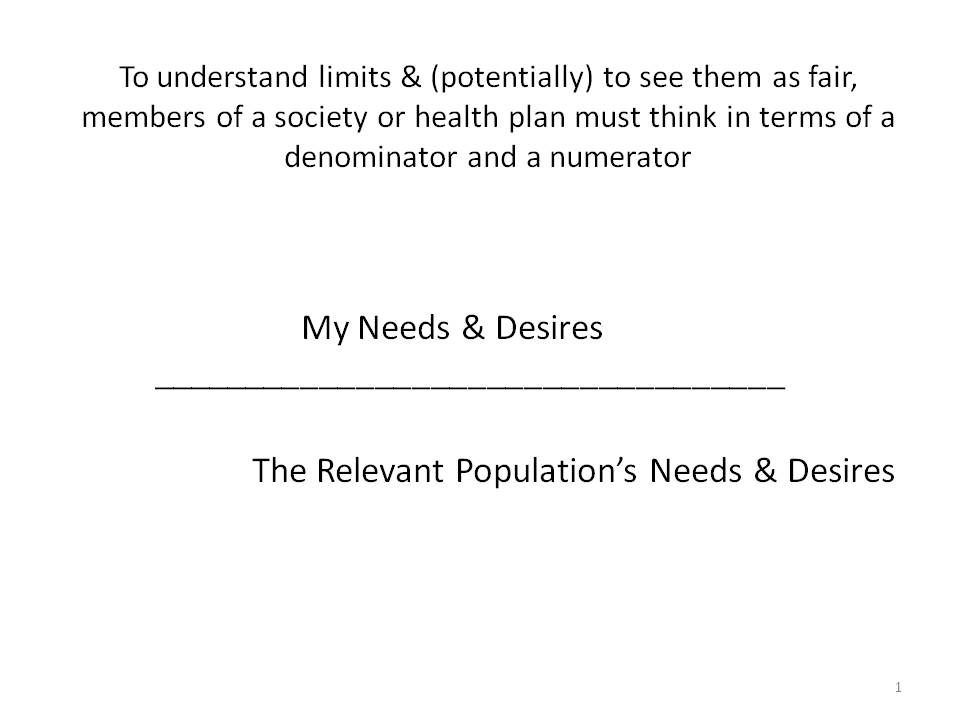
As I'd anticipated, the union leaders evinced a strong sense of solidarity with the insured population and, at the same time, a strong sense of the economic realities of the insurance fund. I presented a diagram I've often used to convey my view of the ethical framework that - ideally - patients, clinicians, purchasers and other stakeholders would use in their dealings with the health system:The idea that we should approach the health system committed to both fidelity to the needs of the individual and stewardship of the resources available for the care of the group was intuitively obvious to the group, as did the metaphor of numerator and denominator that I also like to use::Bringing about a health "system" that is more effective, equitable and efficient in a nation of more than 300 million and a bitterly divided national political process requires won't happen without multiple local initiatives. Oregon, Massachusetts and Vermont show what individual states can do.

The union leaders taught me that union health plans can make important contributions to the national learning curve. Unions are about solidarity on behalf of shared interests. As a population we should be solidly unified on behalf of achieving the best health we're capable of. Sadly, we're not. Union health plans provide a venue in which substantial components of our population are committed to the well-being of each person and, at the same time, to being realistic about how much resource can be devoted to health care. What they learn and demonstrate can help us all.