Monday, 28 November 2011

A Controversial Proposal about Complementary Medicine

A controversial proposal about complementary and alternative medicine (CAM) will be the hot item today and tomorrow at the annual meeting of the College of Physicians and Surgeons of Ontario. Since the College regulates medical practice in Ontario, this isn't a Mickey Mouse discussion!

The College felt it had to create a policy because patients in Canada, like those in the U.S., were voting with their feet - and money - for CAM:
In increasing numbers, patients are looking to complementary medicine for answers to complex medical problems, strategies for improved wellness, or relief from acute medical symptoms. Patients may seek advice or treatment from Ontario physicians, or from other health care providers.
The proposed policy explicitly recognizes a patient's right to decide on the course they want to follow:
Patients are entitled to make treatment decisions and to set health care goals that accord with their own wishes, values and beliefs. This includes decisions to pursue or to refuse treatment, whether the treatment is conventional, or is CAM.
In my psychiatric practice, I heard more than once from patients that their other physicians pooh-poohed psychiatric treatment, especially psychotherapy, with terms like "magic," "witch doctor" and "rent-a-friend." From that experience, I especially liked the way the Ontario College insists that physicians conduct themselves with civility:
The College expects physicians to respect patients' treatment goals and medical decisions, even those with which physicians may disagree. In discussing these matters with patients, physicians should always state their best professional opinion about the goal or decision, but must refrain from expressing personal, non-clinical judgements or comments...about the therapeutic options, or the patient's health care goals or preferences unless those are explicitly requested by the patient.
The fact that many physicians and physician organizations complained bitterly that this standard would "muzzle" them demonstrates the need for making civility and common courtesy an ethical expectation!

The Canadian medical community was especially vehement in its criticism of the way the original draft discussed standards of evidence for CAM. In the eyes of the critics, the College was setting a lower bar of evidence for CAM compared to allopathic medicine. Here's the key passage from the original draft:
Reasonable expectations of efficacy must be supported by sound evidence. The type of evidence required will depend on the nature of the therapeutic option in question, including, the risks posed to patients, and the cost of the therapy. Those options that pose greater risks than a comparable allopathic treatment or that will impose a financial burden, based on the patient’s socio-economic status, must be supported by evidence obtained through a randomized clinical trial that has been peer-reviewed.
To my reading, this statement was entirely reasonable. It's a small percentage of medical practice that's based on rigorous randomized controlled trials. The term "sound evidence" requires explication, but it's the best we can claim for much of what we physicians do. The wording of the revised proposal being discussed in Toronto today makes it clear that the same standard of evidence should be applied to "conventional" and "complementary" medicine. But to my reading it retains an appropriately skeptical view of just how solid the evidence is for what is conventionally done:
Any CAM therapeutic option that is recommended by physicians must be informed by evidence and science, and it must:

• Have a logical connection to the diagnosis reached;
• Have a reasonable expectation of remedying or alleviating the patient's health
condition or symptoms; and
• Possess a favourable risk/benefit ratio based on: the merits of the option, the potential interactions with other treatments the patient is receiving, the conventional therapeutic options available and other considerations the physician deems relevant.

Physicians must never recommend therapeutic options that have been proven to be ineffective through scientific study.
I applied these standards to myself with regard to my treatment many years ago of a patient with trichotillomania (compulsive hair pulling). The literature recommended medication and stated that hypnosis did not work. But my patient didn't want to take medication, and liked the concept of hypnosis, despite what the literature said. We agreed that it seemed relatively risk free, and tried it.

It worked. I didn't see the patient again until 20 years later, when the symptoms recurred. A brief repeat of the hypnosis did the job again. (For a more extensive discussion of the case, see here.) I believe the Ontario College would conclude that the treatment met their standards. I had done the hypnosis, but I hadn't recommended it!

If I were in Toronto today I'd vote to approve the College's proposal. Without demeaning "conventional" medicine it implicitly recognizes the degree to which conventional practice rests on uncertainties. And without using the term "placebo effect" it allows for the provision of interventions - "conventional" and "complementary" - that may well derive their efficacy from the placebo mechanism.

(The proposal being considered by the Ontario College of Physicians and Surgeons can be found on pages 248-275 of the agenda for today's meeting. If you're especially interested in the topic, you can read the original policy statement draft here. A summary of the Canadian Medical Association's criticism of the original draft is here.)

Tuesday, 22 November 2011

Learning from Massachusetts Health Reform

The Blue Cross Blue Shield Foundation of Massachusetts has just published a report on the first five years of Massachusetts health reform. The report provides valuable lessons about how U.S. society can learn to improve access and set limits on costs. It's crucial for us to understanding the learning curve for health reform. Reforming the health system isn't primarily an intellectual challenge. The difficulties are mainly in our own psyches, and among the different players on the health care chess board.

As I see it, the key aspect of Massachusetts health reform is the process by which it came about. Prior to passage of the 2006 law, there were several years of discussions, reports, conferences, committee meetings, and more. From this combination of education, argument and deliberation, what emerged was a consensus that government, employers, and individuals had to share responsibility for making things better. And, at least as important, all that interaction created some trust among the key parties and a culture of civility that is all-too-lacking in the pathetic national non-dialogue on federal reform. The term "Obamacare" is a symptom of the lack of dialogue and civility.

In terms of shared sacrifice: individuals accepted a mandate that we be insured; employers accepted a requirement that they provide insurance or pay into a state pool; and the state accepted responsibility for subsidizing low income folks and for creating a mechanism - the Connector - to administer the new forms of insurance that were made available.

Massachusetts has reduced its uninsured population to 1.9%, compared to the shameful national average of 16.3%. The cost of the subsidized insurance has gone up 3% per year, significantly lower than the national average. Approval of the 2006 law has remained steady at two thirds of the adult population.

Massachusetts explicitly chose to tackle coverage before squaring off with cost. The five year report documents that coverage is relatively "solved." Now the state is turning its attention to cost.

It looks to me as if we're approaching the cost problem the way we approached coverage - with LOTS of talk. We've had multiple reports, all of which say much the same thing - that providers with market clout get paid high prices without delivering comparably superior outcomes, that the entire system has a great deal of waste, and that cost escalation is strangling the businesses, public agencies, and individuals, who pay for care. As I wrote back in March, Massachusetts is the jawboning capital of the western world (see here).

Wise psychotherapists understand that dealing with the resistance to change is the hard part of the work. Once resistances have been dealt with, things get easier. And the late management guru Tony Athos described Japanese management style in the same way - LOTS of process to bring about consensus and then much smoother implementation than we see with our "process-lite" U.S. approach.

I believe, and hope, that what we're seeing in Massachusetts now with with regard to health care costs is creating the human and social infrastructure we need to get a grip on costs. The next report, five years from now, will reveal whether this is true or not.

(The five year report, written by my former colleague Alan Raymond, is very readable. If you're interested in learning more about Massachusetts health reform, take a look.)

Sunday, 20 November 2011

Zeke Emanuel on Health Reform

Zeke Emanuel provides an excellent piece of public education about the potential for improved quality of care and cost savings in a recent New York Times blog post. The piece will be especially informative for folks who don't understand how fragmented the U.S. care system has become and how fee-for-service reimbursement promotes the fragmentation. Emanuel concludes, correctly, that there's substantial potential for improving care for patients with chronic illness, and that these improvements can achieve savings for the health system.

But I think Emanuel makes two mistakes in the piece. Both come from misinterpreting the psychological underpinnings of health reform.

First, after describing very lucidly how bundled payments provide financial support for coordination among caretakers, he explains that "the idea is to force all of a patient's care providers to work together." But "force" is the wrong verb here, and it reflects a mistake medical managers make all too often.

Collaborating with colleagues actually makes practice more enjoyable as well as more effective. Working together in ways that help our patients is intrinsically satisfying. When those in charge assume we clinicians have to be "forced" to do something, we buck them. When they facilitate what good clinicians want to do, we do it with pleasure. The idea of global payments is to "allow" and "support" collaboration, not to "force" it!

Second, Emanuel correctly notes that improved care coordination can produce much more savings than malpractice reform. But apart from the question of how much savings a reduction in defensive medicine might produce, the climate of litigation has a corrosive impact on the psychology of medical care and the doctor-patient relationship. In ethics discussions with medical students, residents, and practicing physicians, the first question is typically - "what does the law say - what happens if I'm sued?"

The spectre of malpractice litigation creates a sense that patients and society are potential enemies. Health reform requires collaboration between doctors, patients, and the wider public. Malpractice reform is crucial not just for whatever money it might save for the health system, but for the potential that reform will reduce the degree to which physicians feel under attack.

Friday, 18 November 2011

Heart-Healthly Plant-Based Thanksgiving Recipes

I want to wish you all a very happy and healthy Thanksgiving!!  I hope you enjoy my holiday recipes. The menu is Holiday Wellington, Wild Rice Cornbread Stuffing, Mashed Potatoes with Mushroom Gravy, Sourdough Bread, Tender Green Bean with Mushroom & Lemon Peel, Spinach Almond Salad, Homemade Whole Cranberry Sauce, Vegan Pumpkin Pie & Sparkling Cranberry Juice. This meal is designed to keep your heart healthy, your energy up, taste fabulous and be packed with delicious plant-based nutritious ingredients like kale, sweet potatoes, spinach, apples, green beans, pecans and cranberries just to mention a few.  What a yummy feast of thanksgiving. I have a lot to be thankful for, and one is that I can share my food and nutrition ideas with all of you. You can do a lot of the preparation for this meal ahead of time and finish on Thanksgiving day. Have an absolutely wonderful time with your family and friends.  Please email me if you have any questions at all on the recipes. Stay happy and healthy:)

Holiday Wellington
Adapted from Morgan's Holiday Wellington  Little House of Veggies
Printable Recipe
(Serves 8)

(2) Homemade pastry dough recipes (see recipe below)
1 bunch of kale, washed, trimmed & chopped
8 oz. sliced baby Bella mushrooms
3 yellow onions, sliced
1 large sweet potato or Yam, peeled &amp sliced
1 ½ cups vegetable broth
1 recipe for sage quinoa (see below)
Red pepper flakes

To Make:
• Start the caramelized onions first. Peel and slice all 3 onions. In a skillet or pot, heat 1 Tbsp of coconut oil over medium high heat. Add the onions, along with a pinch of salt and pepper. Sauté for about 3-4 minutes, stirring occasionally. Add in 2 Tbsp. vegetable broth and continue to cook until the onions are darker in color (slightly brown) and have a sweet taste and very tender texture. While the onions are caramelizing, preparing the rest of the ingredients for the Wellington.
• Start by prepping all of your different ingredients keeping them all separate from each other. Heat a large skillet over  medium heat.
• Start with the kale. Heat 1 Tbsp. vegetable broth in the pan. Add the chopped kale, and a pinch each of salt, pepper, and red pepper flakes. Sauté until softened, about 5 minutes. Remove the kale from the pan and set aside on a plate.
• Add another 2 Tbsp. of vegetable broth to the pan. Add the sliced mushrooms, and a pinch of salt and pepper. Sauté about 5 minutes until the mushrooms are softened. Remove from the pan and set aside on a plate.
• Add 2 Tbsp. of vegetable broth to the pan, and add the yams/sweet potatoes. Add a pinch of salt and pepper and sauté 5 – 10 minutes until tender, but not mushy. Remove from pan and set aside on a plate.

To Assemble the Wellington:

Using a rolling pin, roll out dough on parchment paper to a 17” x 14” rectangle. Begin layering the ingredients on the pastry dough. Once all ingredients are layered, roll up very gently and fold and close up all open ends. Put in a baking dish and bake at 350 degrees for about 1 hour. Brush with olive oil when you have about 10 minutes left to help brown. Remove from oven and allow to cool for 10-15 minutes before slicing.

Sage Quinoa
1 cup uncooked quinoa
2 cups vegetable broth
½ Tbsp poultry seasoning

Put all ingredients in a pan and bring to a boil. Simmer with lid for 25 minutes until all liquid is well absorbed.
Pastry Dough (For Wellington & Pie)
Printable Recipe
(Makes 1 pie)

1 1/3 cups unbleached white flour, whole wheat pastry flour or white whole wheat
¼ cup coconut oil
Dash salt
¾ cup water

Put flour and salt in bowl and stir. Spread pieces of the coconut oil around on top of the flour and cut into flour with either a pastry cutter or a fork. Add water all at once and stir into a ball. Dough will be a bit sticky. Flour board and top of pastry ball. Roll into desired shape.

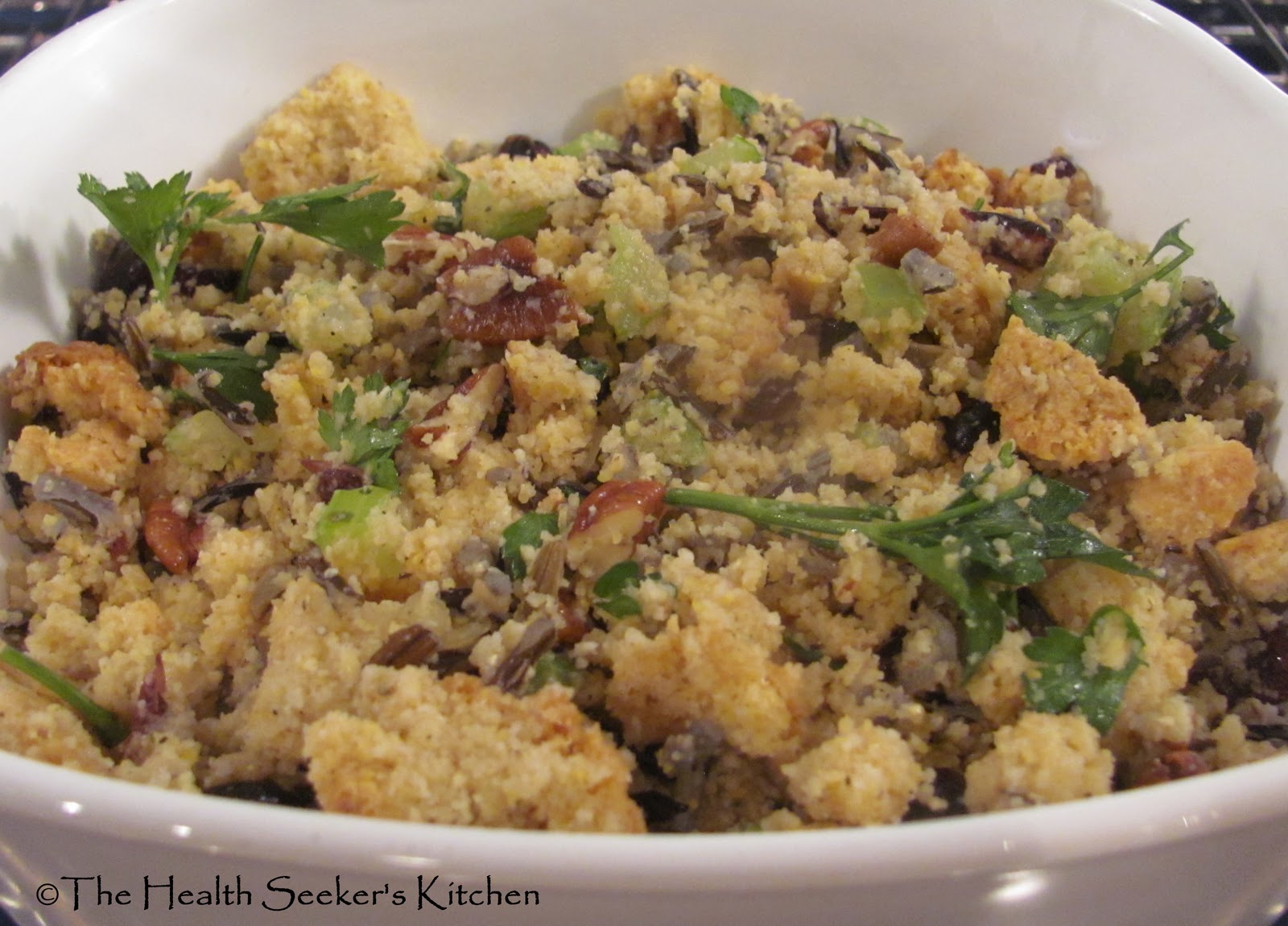
Wild Rice Cornbread Stuffing
Printable Recipe
Wild Rice Cornbread Stuffing By Rachel Spurr, posted on The Kind Life
Serves 6-8

Ingredients
• 2 tbs olive oil
• ¼ onion
• 1 rib celery, cubed small
• ½ apple
• 1/2 tsp rubbed sage
• 1/8 tsp black pepper
• 1/8 tsp sea salt
• 3 cups vegan corn bread, pre-cooked
• 1/2 cup wild rice, pre-cooked
• 2 tbs pecans
• 2 tbs fruit sweetened dried cranberries
• 1/2 tsp poultry spice
• 3/4 tsp sea salt
• 2 tbs parsley
• ½-1 cup vegetable broth

Steps
1. Add the first 7 ingredients to a sauce pan and cook 10-15 minutes or until apples and celery begin to soften.
2. Meanwhile, crumble precooked vegan cornbread into a large bowl.
3. Add wild rice, pecans, dried cranberries, poultry spice, sea salt and parsley.
4. Mix in sauteed mixture, stirring well.
5. Adjust seasonings as desired.
6. Add vegetable broth.
7. For a moisture dressing, more vegetable broth can be added.
8. Place in a well oil pyrex dish or casserole.
9. Bake covered at 350 for 1 hour, uncovering in last 20 minutes of cooking.

Wild Rice
1 cup wild rice
3 cups water

Bring to a boil and simmer until all liquid is gone about 40-50 minutes. Remove lid and fluff with fork. Simmer longer if there is still any additional liquid. Keep lid off until use.

Vegan Cornbread for Stuffing
1 cup cornmeal
1 cup white whole wheat flour
½ tsp. sea salt 4 tsp baking powder
1 Tbsp maple syrup
1 flax egg (make with 1 Tbsp ground flax seed & 3 Tbsp water)
1 cup almond or cashew milk  (make cashew milk by blending 1/4 cup cashews with 1 cup water)

Preheat oven to 425 degrees. Sift together all dry ingredients. Stir all liquid ingredients together and add to dry ingredients. Beat until smooth, but do not overbeat. Bake in a greased 8-inch square pan for 20-25 minutes. Cool and break into pieces to use for stuffing.
Mashed Potatoes & Mushroom Gravy
Printable Recipe

Mashed Potatoes
6 Russet potatoes scrubbed well (leave skins on)
1 recipe cashew cream
Salt and pepper to taste

• Cut up potatoes and place in pan. Cover with water and bring to a boil. Lightly salt water. Boil until potatoes are soft.

• Drain potatoes and place in bowl in preparation for mashing.
• Add 1 cup cashew cream (recipe below) and salt and pepper to taste.
• You can top with a little Earth Balance Butter if desired before serving.

Cashew Cream
½ cup cashews (soak in water for 30 minutes and then drain)
Enough water to make 1 cup with the cashews

After soaking cashews, drain water and then add enough water with the cashews to equal 1 cup. Blend well until smooth and creamy.

Mushroom Gravy
Makes 3 1/2 cups

3 ½ cups vegetable broth, divided
1 cup chopped white onion
4 cloves garlic, finely chopped
 8 oz. sliced mushrooms
2 tsp. dried thyme
1 tsp. dried rosemary
¼ cup apple cider vinegar
2 tbsp Coconut Aminos, Bragg’s Liquid Aminos or Tamari
3 tbsp nutritional yeast
 2 tbsp arrowroot powder or flour
¼ tsp ground black pepper

• In a large skillet over medium-high heat, bring ½ cup broth to a simmer.
• Add onion and garlic and cook for about 4 minutes or until onion is translucent.
• Stir in mushrooms, rosemary and thyme and continue to cook about 2 minutes or until mushrooms release their liquid and start to become tender.
• Add apple cider vinegar and cook 1 minute, stirring constantly. Stir in remaining 3 cups broth and bring to a simmer.
• Meanwhile, in a small bowl, whisk together coconut liquid amino or Bragg’s, yeast and arrowroot powder.
• Add mixture to skillet about 1 tsp at a time, whisking constantly to make sure paste dissolves.
• Bring to a boil and boil 1 minute, stirring constantly. Add pepper and serve.
Mushroom Gravy adapted from Whole Food Market
Whole Cranberry Sauce
Printable Recipe

1 (12 oz.) bag fresh whole cranberries
6 packets stevia (1 1/2 tsp.)
1/3 cup maple syrup (grade B)
½ lemon (juiced)

Add all ingredients to sauce pan. Simmer 10 minutes. Add juice of ½ lemon. Refrigerate to thicken.

Tender Green Bean with Mushroom
& Lemon Peel
Printable Recipe

1 Portobello mushroom sliced
2 tbsp yellow onion diced
¼ tsp oregano
1 tsp olive oil
Salt & pepper

Steam:
1 pound green beans
¼ cup water

Sauce:
Juice of ½ lemon
2 tbsp Vegenaise (grape seed oil)
1/8 tsp dried dill
Rind of 1 lemon (use a lemon zester to produce long thin slices)

• Cook mushroom, onions and oregano in olive oil and season with salt and pepper. Cook until mushrooms look soft and turn color. Remove from pan.
• Add ¼ cup water to pan you cooked the mushrooms in. Add green beans and simmer with lid until all water has disappeared. Remove green beans and place in bowl.
• Mix sauce well and blend with green beans.
• Add mushroom mixture. Add rind of lemon and enjoy.

Spinach Almond Salad
Printable Recipe

1 (10 oz.) bag fresh baby spinach
1 medium Granny Smith Apple
¾ cup toasted slivered or sliced almonds
1 cup fruit juice sweetened dried cranberries

• Place spinach in bowl.
• Slice apple very thin and add to spinach.
• Toast almonds in oven for 300 degrees for around 8-10 minutes and cool. Stir several times while cooking.
• Add cooled toasted almonds to spinach.
• Add cranberries and toss.

Dressing:
¼ cup maple syrup (grade B)
1/3 cup olive oil
¼ tsp salt
3 Tbsp apple cider vinegar
1 Tbsp dried onion or 1/8 small onion chopped finely

Place all ingredients in a blender bottle and shake well. Just before serving, pour dressing over salad mixture and toss.

Sourdough Bread
Adapted from: The Complete Bread Cookbook by Kaufman
Printable Recipe

1 cup sourdough starter (see recipe below)
½ cup lukewarm water
2 tbsp maple syrup (grade B)
3 Tbsp soft Earth Balance Butter
1 cup white whole wheat flour
1 cup unbleached white flour
1 tsp sea salt

• In a large mixing bowl, combine 1 cup starter, water. Maple syrup and butter. Beat well with a wooden spoon until thoroughly blended.
• Add 1 cup whole wheat flour. Mix well. Then gradually add remaining flour until a soft but firm ball is formed. Turned out onto a floured board and knead for 10 minutes until the dough is smooth.
• Turn into a warm greased bowl. Cover and set aside in a warm place until doubled in bulk, about 1 hour.
• Punch down with a wooden spoon, cover and let rise again until doubled in bulk.
• Turn out onto a floured board and knead for 5 minutes. Shape into a ball. Place in a well-greased and lightly floured ovenproof 1½ quart round bowl, or if desired, shape into a loaf and bake in a well greased 9-inch loaf pan.
• Cover and set aside in a warm place until doubled in bulk.
• Make a crisscross on top of round loaf.
• Bake in a preheated 400 degree oven for 35 to 40 minutes or until done. Tap loaf; when it sounds hollow it is done.
• Cook on wire rack.

Sourdough Starter
2 tsp instant yeast
1/3 cup lukewarm water
1 cup lukewarm water
2 tsp maple syrup (grade B)
1 cup unbleached white flour or white wheat flour

• Sprinkle dry yeast over 1/3 cup lukewarm water. Add maple syrup and stir.
• Cover and let stand for 5 minutes until the mixture begins to foam. Add 1 cup lukewarm water, and flour. Beat well with a whisk or beater until well blended.
• Pour into a large wide-mouthed jar. Cover lightly with lid and let stand in a warm place for 2 to 3 days until the starter is a bubbly foaming mass.
• After a day or two the liquid will rise to the top, mix gently with wooden spoon to blend. Use 1 cup of the starter at a time for your sourdough bread recipe.
• After using 1 cup replace with ½ cup flour, ½ cup water and let sit at room temperature for a few hours and then place back in refrigerator with lid on. You can pour off the liquid if it has been sitting in the refrigerator for days without use.
• When ready to use again, add ½ cup flour, ½ cup water, and stir with wooden spoon.  Let sit to warm up and get bubbly. Use 1 cup for recipe and replace with ½ cup flour and ½ cup water. Let sit at room temperature for a few hours and then place back in refrigerator with lid on.
• Repeat this process and you will continually have a sourdough starter ready to use.
• If the sourdough starter ever stops creating bubbles, begin with step 1 in a new jar and repeat process.. Enjoy!!
Adapted from: The Complete Bread Cookbook by Kaufman


Vegan Pumpkin Pie
Printable Recipe
(Makes 1 pie)

1 (14 oz.) can 100% Pumpkin
½ tsp sea salt
1 tsp ground cinnamon
½ tsp ground ginger
¼ tsp ground cloves
1 cup cashew cream (see recipe below)
½ cup maple syrup (grade B)
1 tsp vanilla
4 packages stevia (1 tsp)
2 tsp (Orgran) No-Egg (natural egg replacer) plus 4 tbsp water
1 pastry dough pie crust

• Mix pumpkin, salt, and spices together. Add cashew cream, maple syrup, vanilla and stevia.
• In a small bowl mix 2 teaspoons of the (Orgran) No-Egg replacer with 4 tbsp water. Mix well and then add to pumpkin mixture.
• Place in whole wheat pastry and cook at 425 degrees for 15 minutes. Then turn oven down to 350 and continue to cook for an additional 40-50 minutes. Watch carefully to not over-brown the crust.
• Top with non-dairy whipped topping.

Cashew Cream
½ cup cashews (soak in water for 30 minutes and then drain)
Enough water to make 1 cup

After soaking cashews, drain water and then add enough water with the cashews to equal 1 cup. Blend well until smooth and creamy.
Non-Dairy Whipped Topping
Printable Recipe

1 (13.66 fl. Oz.) Coconut Milk-refrigerate overnight
3 packets stevia (3/4 tsp)
¼ tsp xanthum gum (optional)
2 tsp maple syrup (Grade B)
1 tsp vanilla

Open coconut milk and scoop out all the solid portion and place in whipping bowl. Discard liquid portion. Add stevia and xanthum. Whip until fluffy. Add maple syrup and vanilla. Continue to whip. Store in refrigerator until ready to use.

Wednesday, 16 November 2011

Public Altruism about Health Care is Alive and Well

Four days ago I discussed Medicare beneficiaries who think about Medicare in terms of future generations and the common good, not just in terms of their own care. That post was triggered by my reaction to hearing this aphorism:
The true meaning of life is to plant trees under whose shade you do not expect to sit.
This morning's Boston Globe included an obituary that made the same point. It told about Paul White, who died at 61 of kidney cancer, after eight years of illness. Here's the relevant passage:
In a life curtailed by cancer there was much to curse, but Mr. White was more apt to speak optimistically about how chemotherapy gave him more time with his five granddaughters and how experimental treatments would provide a foundation for patients he would never meet.

"He just felt he was doing his part," his daughter said. "He kept talking about, 'I'm doing this for the next generation.' I can hear him saying that: 'I'm the guinea pig for the next generation.'"
I've been looking to see if any surveys of Medicare beneficiaries suggest what proportion is moved by concerns about the commons. I haven't yet found what I'm looking for, but I'd predict that it's a substantial number.

The Globe also included this letter to the editor:
Five ways to cut spending on Medicare - from a beneficiary

WHEN SPENDING less on Medicare is suggested, it seems that many people, especially Democrats and those over 65, protest loudly. However, there are ways that Medicare could spend significantly less money without denying anyone medical care that is of value. As a Medicare beneficiary myself, I offer five concrete proposals.

1) Make generic drugs the default for covered prescriptions.

2) Let Medicare negotiate with drug companies on the cost of drugs.

3) Let the Medicare Independent Payment Advisory Board identify medical services that provide little or no benefit, and let Medicare refuse to pay for them, or require significant copayments.

4) For surgery or other major interventions for which there are medically reasonable alternatives, do not pay for those interventions unless patients are fully informed about their alternatives, including no intervention at all.

5) Give providers significant protection from malpractice claims if they can document that patients were well informed before a treatment decision was made.

Congress has made if difficult or impossible for Medicare leadership to take any of these reasonable steps to control Medicare costs. Enacting these reforms could significantly cut Medicare costs with no downside for patients or their doctors.

Jack Fowler

Brookline

The writer is senior scientific adviser for the Foundation for Informed Medical Decision Making. His views here are his own.
Voices like Paul White and Jack Fowler can make an important contribution to our national political dialogue. There's no way to deal with the country's long-term economic health without dealing with Medicare. If enough Americans speak as Paul White and Jack Fowler did it will become harder to argue for the politics of selfishness that our anti-tax zealots are so eager to promote.

Monday, 14 November 2011

Mitt Romney on the Veterans Health System

By temperament I'm an optimist, but Republican pronouncements on health care, like Mitt Romney's proposal for privatizing the Veterans Health system, challenge that stance. Paul Krugman has a powerful op ed on this latest piece of Republican disinformation in today's New York Times.

The Veterans' care system was radically reengineered in the 1990s. It now consistently outperforms the private sector on measures of quality and cost. As Krugman points out, that violates Republican theology. When facts and faith collide, something has to give. Romney isn't dumb, so the differential diagnosis is (1) faith in markets that is so strong he'll deny facts or (2) garden variety political duplicity - (i.e., expeditious lying).

(See this piece in yesterday's Daily Kos for details about the VA program and the Republican knee-jerk assault on public programs.)

Saturday, 12 November 2011

Do Medicare Beneficiaries Only Think About Themselves?

This week I spoke with a friend about my conviction that U.S. political process needs a voice from Medicare beneficiaries advocating for a progressive and sustainable approach to Medicare. I told him that although I don't have survey data to draw on, I believe that many of us folks in the Medicare generation are worried about the impact of runaway Medicare costs on future generations. We're not all like the belligerent elders in the AARP advertisement who warn politicians - if you want my vote, don't touch my Medicare.

My friend responded with an aphorism I'd never heard before:
The true meaning of life is to plant trees under whose shade you do not expect to sit.
I do a lot of walking in the woods and love trees, so the aphorism moved me.

I went back to Erik Erickson, to review his interpretation of the stages of life. I discovered that I misremembered his schema. I mistakenly thought Erickson named the healthy approach to aging "generativity." Erickson actually posits that as the virtue for adulthood. "Wisdom" is what he ascribes to the successful 65+ folks. It's opposite is despair.

Erickson may have been on target when he formulated his views 50 years ago, but I think he's wrong for the present. "Wisdom" as he conceptualizes it involves reflecting on the meaning of one's life. That sounds passive and somewhat narcissistic. What I see, and experience, in the Medicare set, is much better described as a quest for "generativity." The question many pose for themselves is - what can I contribute to the world at this phase of life?

Current political dialogue offers two choices for Medicare policy - "don't touch Medicare" or "tinker with the mechanics - raise the age of eligibility or replace Medicare with a voucher to buy insurance."

No one is talking about a cooperative enterprise in which Medicare moves to sustainability via patients and clinicians cooperating to create a more caring, less technological, approach within an overall budget that doesn't saddle the next generations with crushing debt.

There's more than enough money in our current expenditure to provide excellent care for beneficiaries. The way I make the point to knowledgeable friends is to ask - imagine what Medicare would be like if it was guided by the best clinicians from a population-oriented program like Kaiser Permanente!

(The aphorism comes from the title of a book Wes Henderson (1928-2003), a third generation Canadian, wrote about his father Nelson. It's the advice Nelson gave Wes when Wes graduated from high school.)